Dive theory on a beer coaster
Everything you need to know as a diver about pressure, gas laws and dive safety
We’ve all had to learn it: diving. Or maybe you’re just about to start — in which case, an exciting journey awaits you.
Learning to dive means mastering a range of practical skills, but also gaining a basic understanding of theory. In most sports — like skiing, surfing, tennis, or kayaking — you mainly learn by doing. Only in a few activities, such as flying, skydiving, or sailing, does theory play a more prominent role. Diving belongs in that category — perhaps more than any other sport.
In practice, you’ll learn how to clear your regulator and mask, equalize your ears, share air in an out-of-air situation, swim efficiently with fins, and communicate using hand signals. But learning to dive also means understanding what happens when you go underwater: how depth and pressure increase, what that does to the volume and density of the air you breathe, and how your body responds. We call this dive theory.
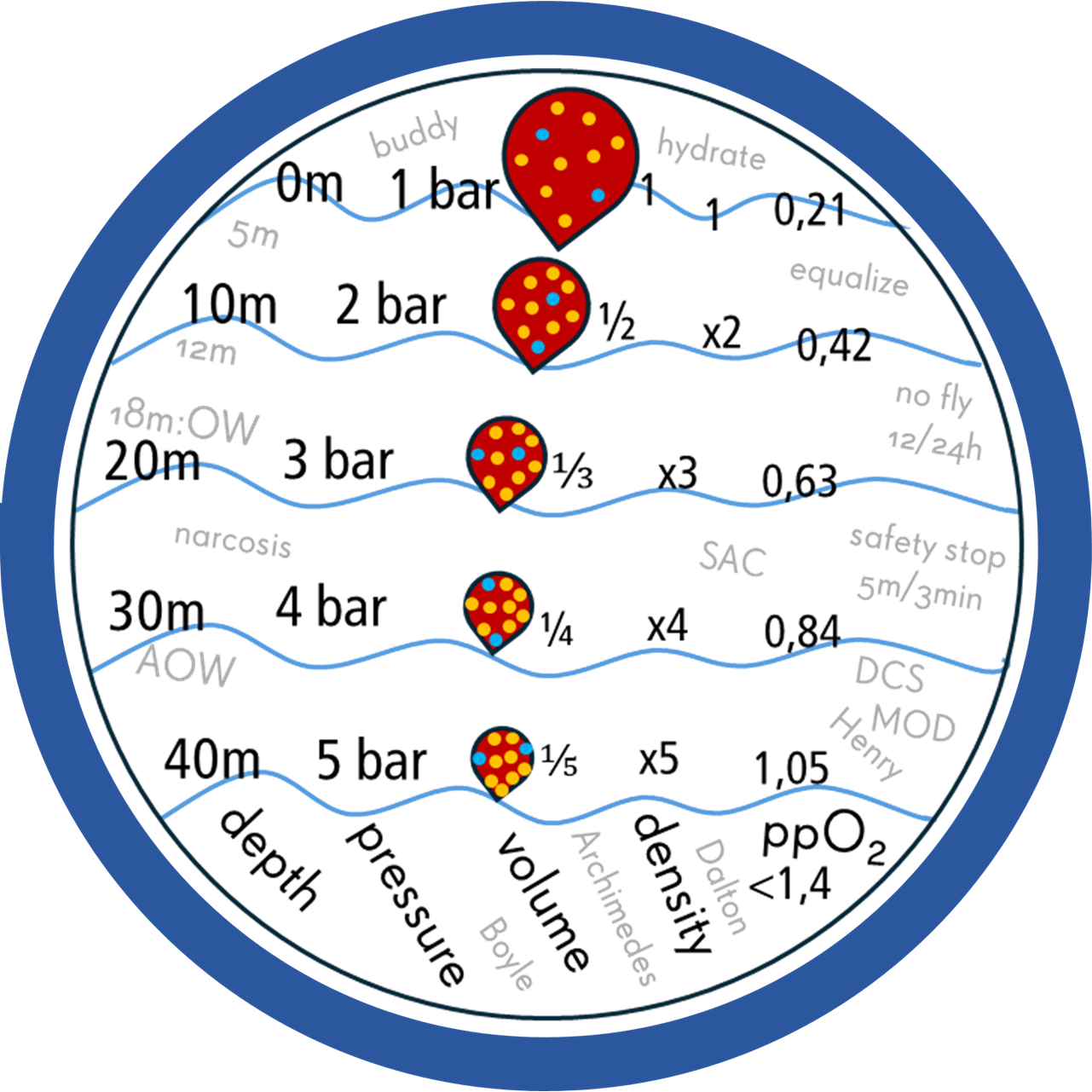
Dive theory can seem complicated at first. Tables, computers, gas laws, safety rules… But the basics of diving are actually surprisingly simple. Once you understand the key principles, almost everything in diving can be traced back to just a few simple rules. In fact, the essence of dive theory fits on a beer coaster. Literally — take a look.


If you have already learned to dive, you will probably understand this beer coaster right away. With almost every word or number, you can recall a memory from your dive training. And if not... then maybe it's time for a little refresher course. 😉 If you haven't learned to dive yet, it might make your head spin for a moment. But actually, it's reassuring: there's not much more to learn than this.
Before we begin, a quick note for our readers from countries (read: that one big country) where the imperial system is still used. In the diving world, we usually work with bar, meters, and liters. That's no coincidence: in the metric system, the relationships between pressure, volume, and gas consumption are much simpler. Anyone who calculates in meters, bar, and liters can immediately see how everything is connected. The same calculations in feet, psi, and cubic feet become incredibly more complicated. That's why many serious divers eventually switch to the metric system—if only because it makes dive planning clearer and less prone to errors.
I can even tell you a story about two novice divers who almost paid with their lives because, in a moment of American naivety, they took 60 meters for 60 feet. A mistake with the remarkable ability to suddenly improve someone's understanding of the metric system. So if, as an American diver, you find yourself with an instructor who is fluent in English but can't calculate flawlessly in feet, psi, and Fahrenheit, don't sigh, but count yourself lucky. It might just save your life one day.
Everything starts with pressure
Let's start at the beginning: pressure increases with depth. Underwater, the pressure rises quickly. At the surface, the pressure is about 1 bar. If you go down to 10 meters, that pressure doubles to about 2 bar. At 20 meters, the pressure is about 3 bar, at 30 meters 4 bar, and at 40 meters about 5 bar. The rule of thumb for divers is therefore simple: every 10 meters deeper means about 1 extra bar of pressure. This increasing pressure affects almost everything you experience underwater—from the volume of air to your air consumption and how your body handles gases. That immediately covers the first two columns on the beer coaster. Now compare this to the beer coaster next to it in the imperial system. Do you see the connection? For every 10 feet, about 4.45 psi is added. Try calculating that in your head.


American manuals therefore usually use a trick. Instead of using depths that make sense to divers (as above), they convert the metric depths of 10, 20, 30, and 40 meters to feet. This results in 32.8, 65.6, 98.4, and 131.2 feet. These are then rounded to 33, 66, 99, and 130 feet. And instead of displaying pressure in the usual unit psi, they introduce ATA (Atmospheres Absolute)—a unit rarely used outside of diving physiology and almost equal to bar, but not quite (1 ATA = 1.01325 bar). You then get the table on the right coaster above. The result suddenly looks surprisingly clear again.
We won't bore you further with more calculations in the imperial system. For practical diving, the metric system simply fits better with the physics underwater. That is also why most divers worldwide eventually use meters, bar, and liters—even if they learned their first dive training in feet and psi. Still, American divers often remain remarkably attached to the imperial system. So much so that a certain dive training organization continues to mention imperial units in all translations of its teaching materials—as if feet and psi are universal units!
Bar is the simplest unit to express pressure. 1 bar is approximately equal to normal atmospheric pressure at sea level. And for every 10 meters, 1 bar of pressure is added. It is also noticeable that the list only goes up to 40 meters. That is not a coincidence: for recreational divers, that is about the maximum depth. Deeper diving falls under technical diving. Technical divers often go into the water with multiple tanks—sometimes three, four, or even more—and with extra equipment. Separate training, specialized equipment, and often other breathing gases are needed for this. Regular recreational diving is much simpler: usually with one tank on your back and regular air as breathing gas.
Boyle: air is compressed
What does that mean in practice? The increasing pressure underwater directly affects the air we breathe. When the pressure increases, air is compressed. A simple rule is: if the pressure doubles, the volume of air halves. That means, for example, that an air bubble at 10 meters depth has only about half its volume. At 20 meters, that's about a third, and at 30 meters, about a quarter of the volume at the surface. This phenomenon is known as Boyle's law: when the pressure on a gas increases, the volume decreases. For divers, this has all kinds of practical consequences. During descent, for example, you must regularly equalize your ears, because the air in your middle ear is also compressed.
The law is named after Robert Boyle, an Irish physicist and philosopher who described this relationship between pressure and volume as early as the 17th century—long before diving with compressed air as we know it today. Boyle conducted this research mainly out of scientific curiosity, but his discovery soon had practical consequences. It helped scientists understand how air pressure works and how gases behave, knowledge later applied in instruments such as barometers and, hundreds of years later, in technologies such as compressors and diving equipment.
Of course, all this doesn't fit on that coaster, and fortunately, you don't have to remember it all. If you want to remember something, just remember the name Boyle. Or even better: remember the principle that the volume of a gas decreases when the pressure increases. That immediately gives us the third column of the coaster. The volume of a gas is inversely proportional to the pressure: the higher the pressure, the smaller the volume—and vice versa: the lower the pressure, the greater the volume.
This also has a very practical consequence for us divers. When we ascend, air expands. Just look closely at the bubbles you or your buddy exhale. As they rise to the surface, they get bigger and bigger. You often even see a bubble split into smaller bubbles, which also get bigger as they rise further. This is also why you should never hold your breath while diving with compressed air. If you hold your breath during an ascent, the air cannot escape from your lungs as it expands. This can cause a lung overpressure injury. As you progress in your diving career, you will learn that there are different forms of lung overpressure injury:
- Arterial gas embolism—air bubbles enter the bloodstream through damaged lung tissue and can block circulation to the brain or other organs (embolism literally means something that is thrown in—so something (like an air bubble) is "shot" into the arteries and gets stuck there).
- Pneumothorax or collapsed lung—air (pneuma) escapes from the lungs into the chest cavity (thorax), causing a lung to partially or completely collapse.
- Mediastinal emphysema—air ends up in the space between the lungs around the heart and the major blood vessels. Doctors call this space the mediastinum.
- Subcutaneous emphysema—air spreads under the skin (subcutaneous simply means "under the skin"), usually around the neck and collarbone.
The word emphysema comes from Greek: em- (ἐν) means "in" and fysein (φυσᾶν) means "to blow". Literally, it means "blown up from within"—exactly what happens when air escapes from the lungs and accumulates in tissue where there is normally no air. But you don't have to memorize all that either. If you remember only one thing, let it be this: never hold your breath while diving. Or even simpler: always keep breathing. That is perhaps the most important rule of diving. And actually, it's a good rule for the rest of your life: whatever happens, always keep breathing. If you do that, chances are you'll live a long life. 😉

Density: why you use more air at depth
The increasing pressure underwater has another important consequence: air becomes denser. This means that with each breath at depth, you inhale more gas molecules than at the surface. This has to do with the relationship between pressure, volume, and density. When pressure increases and volume decreases, density increases. In other words: pressure and density are directly proportional, while volume and density are inversely proportional. You can also see this in the numbers. If you multiply the values from the third and fourth columns of the coaster, you always get 1.
We have also shown this schematically with the balloon on the coaster. The ten yellow and blue balls have much more space in the top balloon, at the surface, than in the balloons below. As the pressure increases, the air particles are forced closer together. That is exactly what we mean by density.
I often explain it even more simply. Suppose you are traveling with a group of friends in a minibus where you all fit comfortably. On the way, the bus breaks down and you are picked up by a small car, for example, a Kia Picanto. If you all want to fit in that smaller car together, it is only possible if everyone sits closer together—literally on each other's laps.
That is exactly what happens to air when the pressure increases: the same amount of air has to fit into a smaller space, so the particles are forced closer together. A direct consequence of this is that you use more air at depth. You use more air when you dive deeper. This is because the air you inhale at higher pressure has a greater density. With each breath, you therefore inhale more gas molecules than at the surface. As a result, your air supply runs out faster.
The effect is easy to understand: at 10 meters you use about 2× as much air, at 20 meters about 3× as much, at 30 meters about 4× as much, etc. You could also say that air becomes "more expensive" the deeper you dive: you get less dive time in return. We can show this schematically on a new coaster. This is of course a simplified example, but it clearly shows how it works: the deeper you dive, the faster your air supply runs out.
When you calculate your personal air consumption, you must therefore link this to the average depth of your dive. Your personal air consumption is often referred to as RMV or SAC. In practice, divers usually mean the same thing: how much air you use per minute, converted to surface conditions. In the metric system, we simply express this in liters per minute.


Dalton: the total pressure is the sum of all gases
Air consists of various gases, mainly nitrogen and oxygen. According to Dalton's law, each of these gases exerts its own pressure. The total pressure is simply the sum of all those individual pressures. Dalton in one sentence: each gas contributes to the total pressure — and that contribution increases with depth.
Dry air consists of about 20.9% oxygen (O₂) and 78.1% nitrogen (N₂). The remaining 1% consists of argon and other noble gases, carbon dioxide (CO₂), hydrogen (H₂), and a range of other molecules, but we will leave those aside here. For convenience, we say that air consists of about 21% oxygen and 79% nitrogen.
At 1 bar, air therefore consists of 0.21 bar oxygen and 0.79 bar nitrogen. If we breathe air at 2 bar at a depth of 10 meters, the inhaled air consists of 0.42 bar oxygen and 1.58 bar nitrogen, and so on. This gives us the fifth column of the beer mat: the amount of oxygen (in bar) at different depths. In the mat below, we show that column again, and also list the amount of nitrogen next to it. We see that together they add up exactly to the total pressure at that depth. Both columns show how much pressure each gas contributes individually — this is called the partial pressure. The composition of the air remains the same, but the pressure with which each gas acts on your body increases. You could say that gases 'work harder' at depth — but what actually happens is that their partial pressure increases.
Nitrogen narcosis
This has various consequences for divers. For example, nitrogen can have a mildly anesthetic effect at greater depths, which we call nitrogen narcosis or gas narcosis. Its effect is somewhat comparable to drunkenness. Most divers experience the first symptoms from about 30 meters. The symptoms are similar to what you feel after your first glass of beer or wine on a warm summer day, when you notice it hits you: you feel a bit lightheaded and maybe a bit euphoric — or perhaps a bit anxious. In any case, it doesn't make you sharper.
It's not called narcosis (anesthesia) for nothing. Your motor skills become a bit clumsier, your thinking slows down, and problem-solving becomes more difficult. In itself, this is not immediately dangerous, but if something goes wrong, you want to stay sharp. Fortunately, the effects usually disappear quickly when you ascend a bit. And you won't have a hangover afterwards. But if you go even deeper, the narcotic effect becomes stronger.
Speaking of alcohol: what applies to driving under the influence — don’t drink and drive — also applies to diving: don’t drink and dive. But anyway — back to physics.
Oxygen toxicity and your MOD
On the original beer mat, we only mentioned the partial oxygen pressure (ppO₂) and not the partial nitrogen pressure (ppN₂). For oxygen, these values are important when diving, while the partial nitrogen pressure for most recreational dives does not directly set a limit. The partial oxygen pressure must not exceed about 1.4 bar. Exposure to higher values carries an unacceptable risk of oxygen toxicity. When diving with regular air and not going deeper than 40 meters, this is really only a theoretical limit. With air (21% oxygen), you only reach a partial oxygen pressure of 1.4 bar at around 56 meters depth, well below the recreational diving limit.
But when diving with Nitrox — which is also popular among recreational divers — that limit can fall within the recreational depth range. Nitrox contains extra oxygen: for example, you breathe 32% or 36% oxygen instead of 21%. As a result, you reach a partial oxygen pressure of 1.4 bar much sooner, namely around 34 meters with EAN32 and around 29 meters with EAN36 — so within the limits of recreational diving. Anyone diving with Nitrox must therefore know their Maximum Operating Depth (MOD) – another term found on the beer mat.
If you exceed your MOD, you expose yourself to the risk of oxygen toxicity. Your body then receives too much oxygen at once. At too high a partial oxygen pressure, oxygen can have a toxic effect on the central nervous system. The electrical activity in the brain is disrupted, which can lead to a sudden epileptic-like attack — a so-called seizure or convulsion — with uncontrolled muscle contractions or cramps throughout the body. On land, such an attack is already serious enough, but underwater it is particularly dangerous: a diver can lose consciousness or lose their regulator and thus drown. That is why it is important to always make sure you do not exceed your MOD.
How to calculate your MOD, how to analyze the air you breathe, and how to correctly set your computer for use with enriched air, you will learn in the specialty course Enriched Air Nitrox.

Anglocentrism
That’s it for Dalton. By the way, Dalton was not one of the brothers Joe, William, Jack, and Averell from the Lucky Luke comics, but John Dalton. This Dalton was an English physicist and chemist who lived around 1800 and became famous not only for his gas laws, but also for his contributions to meteorology and the study of color blindness. Fun for a pub quiz, but you don’t need to remember this. Just remember that air is a sum of different gases and that when the pressure increases, the partial pressure of each individual gas increases proportionally.
In the names of these laws, the diving world may be a bit anglocentric. What is usually called Dalton’s law in international diving literature is often referred to in French texts as Gay-Lussac’s law or as the law of Dalton and Gay-Lussac. The French physicist Joseph Louis Gay-Lussac conducted similar experiments with gases and partial pressures and reached similar conclusions to Dalton in the first decade of the nineteenth century.
For a similar reason, Boyle’s law is also called the Boyle-Mariotte law, to also give recognition to the French physicist and priest Edme Mariotte, who independently described the same relationship between pressure and volume at about the same time.


Henry: gas absorption, decompression, and recompression
This is not the whole story yet. The different gases we breathe are absorbed by our blood and reach all our body tissues through the circulatory system. Those tissues take up oxygen and release carbon dioxide. Even though our tissues do not need nitrogen, it is still absorbed and released by our body tissues. Gradually, this nitrogen accumulates in all our tissues. The longer and deeper we dive, the more nitrogen our body absorbs. We also need to release it slowly, through the same circulatory system and our breathing. That is why it is important to ascend slowly and make a safety stop during the ascent. This gives the body time to safely eliminate the dissolved gas. This brings us to the topic of decompression sickness, but before we go further into that, it is good to briefly summarize where we stand so far.
There are four names on the beer mat: Archimedes, Boyle, Dalton, and Henry. Together, they form the basis of almost everything that happens underwater when we dive. We will save Archimedes for last. We started with Boyle—the first important gas law for diving. His law describes how pressure and volume are related: when pressure increases, the volume of a gas decreases. That explains why air bubbles become smaller at depth and expand again as they ascend—and why you should never hold your breath while diving. We also saw that when the volume decreases, the density of air increases. As a result, you inhale more gas molecules with each breath at depth and therefore use up your air supply faster. The deeper you dive, the faster your air runs out. With Dalton, we saw that air consists of different gases—mainly nitrogen and oxygen—and that the total pressure is equal to the sum of the individual pressures.
And then there is Henry. William Henry was a physician and chemist, and not only a contemporary but also a fellow citizen of Dalton. Both scientists worked around 1800 in Manchester and presented their research at the same scientific society, the Manchester Literary and Philosophical Society.
Henry's law is the third important gas law for diving and describes that gases dissolve more easily in liquids under higher pressure—and thus also in the human body. During a dive, nitrogen gradually dissolves in your tissues. When you ascend, that gas must also be able to safely leave the body. And that brings us to the next topic: decompression.

Decompression sickness
As long as you remain under pressure, the gas stays neatly dissolved in your body. But when the pressure decreases during ascent, that dissolved gas wants to come out of solution again. Normally, this happens gradually via the blood and lungs, after which it is simply exhaled.
If the pressure drops too quickly, the gas cannot be removed quickly enough via the blood circulation and lungs, and gas bubbles can form in tissues and blood vessels. According to Henry's law, more nitrogen dissolves in the body during a dive the longer and deeper you stay under pressure. If you ascend too quickly, the dissolved gas cannot be exhaled in a controlled way through the lungs and comes out of solution as bubbles along the way. This process is a bit like what happens when you open a bottle of soda: as long as the bottle is closed, the carbon dioxide remains dissolved in the liquid. But as soon as the pressure is released, small bubbles form everywhere. When such bubbles cause symptoms in the body, we speak of decompression sickness (often abbreviated as DCS, or in Dutch DCZ – Decompressieziekte).
One factor that is often underestimated is hydration—or simply: drinking enough water. Diving can cause unnoticed dehydration. Sun, salt water, cold, and breathing dry compressed air all cause you to lose fluids faster than you think. When the body becomes dehydrated, the blood becomes a bit thicker and the transport of dissolved gases through the body becomes less efficient. That is why a simple but important rule of thumb is: drink enough water before and after diving.
These bubbles can cause damage in various ways. For example, they can irritate or damage nerves, cause pain in joints and muscles, and disrupt blood circulation by partially blocking small blood vessels. The skin can also be affected. Some divers experience itching, a red or blotchy rash, or a marbled pattern on the skin. This is also called skin bends or cutaneous decompression sickness. Such a skin symptom may sometimes seem harmless, but it should be taken seriously, as it can be a sign that bubbles are also forming elsewhere in the body.
First aid and the recompression chamber
In diving medicine, decompression sickness is traditionally divided into two types. Type I DCS includes the milder forms of decompression sickness. These mainly involve symptoms of the skin, muscles, and joints. The best-known form is the classic "bends," pain in the joints caused by gas bubbles in or around the joint. Skin symptoms, such as itching, rash, or a marbled pattern on the skin (skin bends), usually fall under type I. Type II DCS involves the more severe forms of decompression sickness. These often affect the nervous system, inner ear, or lungs. This can lead to symptoms such as paralysis, sensory disturbances, balance problems, or breathing difficulties. These forms always require prompt medical treatment.
In practice, however, divers take all forms of decompression sickness seriously. Even symptoms that seem mild at first glance can be an indication that gas bubbles are forming somewhere in the body. The first aid for suspected decompression sickness (DCS) is always the administration of pure oxygen. That is why dive schools always have oxygen equipment available. During first aid courses given by diving organizations—such as React Right—you also learn how to administer emergency oxygen correctly.
Oxygen is not only important in decompression sickness. It is also often an important first aid measure in other diving-related problems, such as lung overpressure injuries (which we mentioned earlier). Further medical assessment and treatment are then crucial. In the hospital, a diver with possible decompression sickness is usually treated by a diving physician, often in a department of hyperbaric medicine. Hyperbaric literally means "under increased pressure," which refers to treatment in a pressure or recompression chamber.
A recompression chamber (also called a hyperbaric chamber or pressure chamber) is a room in which the air pressure can be artificially increased. In such a chamber, the patient is put under pressure again—usually to a pressure comparable to a dive of about 18 meters depth (about 2.8 bar). This has two important effects:
- The gas bubbles become smaller
According to Boyle's law, gas bubbles become smaller as the pressure increases. As a result, they take up less space and cause less damage in tissues or blood vessels. - Nitrogen can dissolve again and leave the body
Due to the higher pressure and the duration of the treatment, the body has the opportunity to gradually eliminate the dissolved nitrogen gas via the blood and lungs.
During the treatment, the patient usually breathes 100% oxygen. This speeds up the removal of nitrogen from the body and ensures that tissues that temporarily receive less oxygen still get enough oxygen.

From Dive Tables to Dive Computers
So far, we have mainly looked at what happens physiologically in the body during a dive. Thanks to Henry's law, we know that nitrogen dissolves in our tissues under pressure and that this gas must be safely eliminated during ascent. The next question, of course, is: how do divers know how much nitrogen their body has absorbed and how quickly they can ascend safely? In other words: what is too deep, what is too long, and what is too fast?
Divers use dive tables and dive computers for this. In the early days of recreational diving, dives were planned using dive tables. These are tables where, based on depth and dive time, you can read how much nitrogen your body has approximately absorbed and how to ascend safely. Dive tables were the first attempt to make Henry's law practically applicable. The first dive tables were developed for military divers, for example by the U.S. Navy. Later, tables were developed specifically for recreational diving, and different dive organizations use their own variants.
Nowadays, however, most divers use a dive computer. Such a computer continuously measures depth and time and calculates how much nitrogen has likely built up in your body. Based on this, the computer shows you during the dive how much no-decompression time you have left. In Dutch, we also call this no-decompression time your 'nultijd'.
At the start of a dive, you will often see the number 99 on your dive computer screen. That is the no-decompression time (in English: no-decompression limit or NDL). The longer and deeper you dive, the smaller that number becomes. For example, if you see the number 30, it means that at your current depth, you can stay for a maximum of 30 more minutes without a decompression obligation. If you stay longer or go deeper, that number will decrease further.
That number must always remain greater than zero — hence the term 'nultijd'. Recreational diving is based on the principle that dives stay within the limits of the no-decompression times, so without mandatory decompression stops. If you dive within your no-decompression time, you can, in principle, end your dive at any time and ascend calmly to the surface. In technical diving (dives where decompression obligations do arise), this is different. These divers cannot simply ascend directly but must make planned decompression stops. Therefore, technical diving requires much stricter planning of depth, dive time, and gas supply.
Here is a linguistic footnote. In Dutch, we often talk about 'nultijd'. This term also exists in German (Nullzeit), in the Scandinavian languages (nultid, nolltid, nulltid, núlltími), and even in Finnish (nollaaika) and Estonian (nullaeg). In English and most other languages, however, people speak of no-decompression limit (NDL) or no-stop time — literally: the time in which you can ascend without decompression stops. The term 'nultijd' comes from the era of dive tables. Those tables had a column for decompression stops. As long as it said '0 minutes', you were within the no-decompression time. Dive computers today use exactly the same principle but calculate it automatically for you during the dive.
Safe Ascent: No-Decompression Time, Safety Stop, and No-Fly Time
Your dive computer also monitors your ascent rate during the dive. If you ascend too quickly, the computer usually gives a warning. The recommended maximum ascent rate is about 9 meters per minute — roughly slower than the small air bubbles you exhale. That is why a dive usually does not end with a direct ascent to the surface. Just before surfacing, we almost always make a safety stop.
A safety stop is a short pause during the ascent, usually about 3 minutes at a depth of around 5 meters. During those few minutes, the body gets some extra time to safely eliminate dissolved nitrogen through the lungs before you go all the way to the surface. Strictly speaking, a safety stop is not mandatory for recreational dives as long as you stay within your no-decompression times. But it is strongly recommended, and most divers almost always do it. After all, it never hurts to give the body a little extra time to eliminate gas. You should not take the 5 meters too literally. In practice, a safety stop is somewhere between about 3 and 6 meters deep. As long as you stop for a moment in that last part of the ascent and keep breathing calmly, the stop is effective. Many dive computers help you with this. When you approach 5 meters during the ascent, the computer will often automatically start a 3-minute countdown for a safety stop.
Also note that the way we often dive in Curaçao — namely from the shore — usually already includes a very gradual ascent. Instead of a clear bottom time followed by a real ascent, the second half of the dive often proceeds as a long, slow ascent along the reef. Often, at the start of the dive, we first swim to deeper water. When we turn around and swim back toward the shore, we usually also begin that long, calm ascent. As we dive back, the water gradually becomes shallower. By the time we reach our safety stop, we have often already completed a large part of the ascent. And even after the safety stop, we usually do not go straight to the surface. We often continue swimming calmly in the shallow water until we can simply stand up and walk out of the water among the beachgoers. This also contributes to a gradual and relaxed end to the dive.
We also usually ascend very gradually during our boat dives. The only difference is that after the safety stop — for which we usually swim away from the reef and into the blue water — we do ascend directly to the surface, because we return to the boat. We therefore deliberately do the safety stop not above the reef or near the shore, but in open water, so the boat can safely pick us up there. If you pay attention along the coast of Curaçao, you can still see some examples of boats that once handled this a little less conveniently. Of course, we prefer to avoid that.
Even after the dive, some nitrogen often remains in the body. That is why divers are advised not to fly for a certain period after diving. In an airplane, the air pressure is lower than at sea level, so dissolved gases can form bubbles again. This waiting period is called the no-fly time.
Something similar applies when you travel quickly to high altitude after diving, for example to a mountain area or a high-altitude lake. The air pressure is also lower there than at sea level. In practice, this hardly plays a role in Curaçao, but at some dive destinations — especially in mountainous areas — you do need to take this into account. There are also other special procedures for mountain lake diving. If you ever plan to do this (in Austria, Guatemala, or Colorado, for example), take an altitude diving specialty course.
After a single dive, it is recommended to wait about 12 hours before flying or driving into the mountains. After multiple dives or several days of consecutive diving, the advice is to wait 24 hours. There are two ways to coordinate this: if you know what time your flight departs, adjust your last dive accordingly. Those traveling by private jet and with their own flight crew can, of course, simply adjust the flight schedule to the last dive.
Archimedes, Buoyancy, and the Buddy System
But back to the original beer coaster. We have now discussed almost everything on it in detail, except for two terms: Archimedes and buddy. Archimedes is, after Boyle, Dalton, and Henry, the fourth name on the list. We discuss him here last — even though he is actually the oldest of the four. Much older, in fact, than the other three. So, think of Archimedes as your dive buddy. How great is that: diving with an ancient Greek philosopher as your buddy.
Archimedes of Syracuse: “Eureka!”
Archimedes was one of the greatest mathematicians and physicists of antiquity. He lived in the 3rd century BC in Syracuse, a Greek city on Sicily, where he worked at the court of King Hieron II during the turbulent times of the Punic Wars between Rome and Carthage.
You probably know him mainly from two famous quotes. The first is about the lever effect. He is said to have once said: “Give me a place to stand and I will move the earth.” Of course, he did not mean that he literally wanted to lift the earth, but that with a sufficiently long lever and a fixed fulcrum, even a huge mass can be moved with a relatively small force. The second quote is perhaps even more famous: “Eureka! Eureka!” (εὕρηκα! εὕρηκα!) — “I have found it!”
According to a famous anecdote, Archimedes once received a task from King Hieron II of Syracuse. The king had a golden crown made for a temple but began to suspect that the goldsmith might have replaced some of the gold with cheaper silver. He wanted to know if the crown was made of pure gold — but without damaging or melting it. That seemed a difficult problem. How can you determine the purity of an irregularly shaped object without destroying it?
Archimedes is said to have thought about this for a long time without finding a solution. Until one day, in the bathhouse, he noticed that the water level rose when he got into the bath. At that moment, he realized that an object submerged in water always displaces an amount of water exactly equal to its volume. With this, he had found the solution to the crown's problem. If the crown was not made of pure gold, but for example partly of silver, then at the same weight it would have more volume and thus displace more water than a block of pure gold. By measuring how much water the crown displaced, he could determine whether the gold was really pure. When he noticed this, he jumped out of the bath with joy and ran home naked, shouting that he had found what he was looking for. And as he ran and shouted loudly, he said in Greek: “Eureka! Eureka!” — “I have found it!”

Neutral Buoyancy
Whether the story happened exactly like that, we do not know, but it nicely illustrates what we still call Archimedes' principle today: a body submerged in a fluid experiences an upward force equal to the weight of the displaced fluid.
When we dive, we also displace water. You just do not notice it as you do when you step into a full bath, because a diver is unimaginably small compared to the sea. Yet we constantly experience this principle. It is precisely this upward force of water that determines whether we sink, rise, or can hover.
That may sound like a bit of physics again, but for divers, it is actually very practical. It explains why we can hover underwater. With our lungs, our buoyancy control device (BCD), and our weight system, we constantly regulate how much water we displace and how much we weigh relative to the amount of water we displace. The goal is to be exactly in balance: not sinking, not rising, but neutral buoyancy.
When that works, you move through the water as if you are weightless. You do not have to constantly kick to stay at depth, and you do not accidentally touch the reef with your fins or knees. Good buoyancy is therefore not only more comfortable but also safer and better for the reef.
In a sense, everything we have discussed above comes together here. Pressure, gas laws, air consumption, and decompression are all important — but ultimately, good diving is mainly about calmness, control, and awareness underwater. And there is one simple rule that should not be missing from any beer coaster.
Never Dive Alone
Diving is essentially a buddy activity. This means you always dive with a partner who keeps an eye on how you are doing — and vice versa. Most dives go smoothly, but when something unexpected happens, a buddy is often the first and most important form of help. Your buddy can help, for example, when your mask fills with water, you lose something or get entangled, you need to calm down or orient yourself, or your air is running low. The most important tool underwater is therefore not your equipment or your computer, but the diver next to you.
For completeness: there are exceptions. Very experienced divers can learn to dive independently with special training, for example in an independent or solo diving course. There you learn how to dive safely without a buddy using redundant equipment, extra gas supply, and careful dive planning. But for most divers, the buddy system remains one of the most important safety principles underwater.
The Essence of Dive Theory
And with that, we are actually back at the beginning. The physics of diving fits on a beer coaster, but good diving itself ultimately comes down to a few simple principles: breathe calmly, ascend slowly, keep a good eye on your buddy, and use a bit of common sense. The rest will follow naturally.
If you remember only one thing from this whole story, it is this: the deeper you go, the greater the pressure. And that pressure affects everything we do underwater: our air consumption, our buoyancy, the absorption of gases in our body, and the safety of our ascent.
The rest is really just detail. Or as we like to say at Porto Mari: dive theory fits on a beer coaster.