


Working as a dive pro
The reality behind the dream life
From Passion to Profession
Almost everyone who becomes a dive professional starts with the same motivation: a love for diving. You probably recognize it: you look forward to your next dive. You watch videos, read articles, talk about it with others. Diving is something special — something you make time for. It becomes more than just a hobby. It becomes something you organize everything around.
I learned to dive myself alongside an academic career. I dived in my free time, next to a life focused on research, teaching, and international conferences. Almost every trip automatically became a dive trip — or at least: an attempt at one.
I did my Open Water course after a conference in Singapore. During a winter school in Athens, I spent a free day making two dives — and spontaneously took a Nitrox course as well. Before and after a workshop in Cape Town, I reserved extra days to dive in kelp forests and to see the great white sharks. My fieldwork in Guinea-Bissau (West Africa) preferably started or ended in Cape Verde or Dakar, Senegal, because then I could also dive for a day or two. Even family vacations quickly got a second agenda: could we go diving too? That’s how we ended up in Portugal, Egypt, and eventually Curaçao, among other places.
At a certain point, I noticed something shifted. I spent more time and energy researching diving opportunities than on the program I was actually traveling for. I thoroughly investigated whether diving was possible in Ghana (it turned out not to be feasible), delved into obscure dive locations near São Paulo (too complicated), and tried to organize dives in Denmark (logistically surprisingly difficult). Diving was no longer a hobby that was just "on the side." It became something everything started to revolve around. And then, the step to working in diving suddenly becomes much smaller.
It sounds like a logical next step. If you love doing something, why not make it your profession? But somewhere along the way, something changes. Diving is no longer something you look forward to. It becomes something you do every day. Even when you’re tired. Even when you don’t feel like it. Even when the conditions aren’t ideal. That’s not a problem — but it is a reality you need to be aware of. Those who turn their hobby into their job need to look for a new hobby. That doesn’t mean the fun disappears. But it does mean it changes.
In this chapter, we look at the life behind the work of a dive professional.
We discuss what it means to turn your hobby into your profession, and how that change affects your relationship with diving. We discuss the reality of working in the dive industry: from income and career choices to social dynamics and working with people every day. We also pay attention to less visible aspects, such as responsibility, physical strain, and the boundaries you need to guard for yourself. Finally, we look at how to sustain the work in the long term — and how to keep the joy in diving.
Money and Career
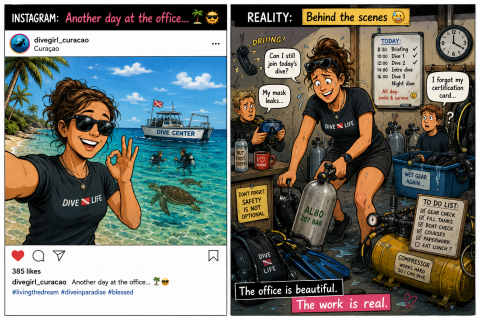
There is often a romanticized view of working in the dive industry. Sun, sea, freedom. Dive shops and dive instructors like to make people outside the dive industry a bit jealous and regularly post photos of white beaches and azure blue seas with captions like “Another day at the office.” “Living the dream” is another slogan often attached to the job of dive instructor, not least by divemasters and instructors themselves. We actively participate in this image-building. For dive shops, it’s marketing that should make customers long for their next dive trip. For dive professionals, these kinds of images and posts on their social media are a way to justify to family and friends back home their unusual choice of lifestyle—a justification that apparently needs to be shared in vivid detail on a regular basis.
And this image does indeed reflect our work. But it’s a very optimistic, rosy picture, not a complete one. Anyone seriously considering a career in the dive industry should develop a more realistic view of life and work before starting, otherwise disappointment may follow. Those with realistic expectations are more resilient than those chasing a naive dream.
Let’s start with what you probably already know: most dive professionals do not earn a high salary. Those who trade a career as, for example, a nurse, teacher, or salesperson for a life as a dive professional under the sun often have to settle for half or less of the financial reward, and also for far fewer social benefits such as social security, pension accrual, etc. The work of a dive professional usually takes place in countries and parts of the world where working conditions—especially for expats and temporary foreign workers—are much less favorable than in the Netherlands or Belgium. Moreover, much of the work in the dive industry also takes place in the gray area between official work in the formal sector and informal, untaxed work.
The income of a dive professional often consists of a combination of a base fee, tips, overtime for things like night dives, and sometimes commission on courses or sales. Moreover, in many cases, it is seasonal work. This means your income can fluctuate. Sometimes you work harder for the same money. In many places around the world, you are expected to be available six days a week during the high season. And when the season ends, your contract usually ends immediately as well.
Some dive instructors therefore combine their work in the dive industry with other seasonal work, such as being a ski instructor. This means you have to move twice a year: after the winter season from the mountains to the sea, and after the summer season the other way around. We once had an instructor from the Netherlands who divided his year into 4-5 months in Andorra (in the Pyrenees) and 4-5 months in Curaçao, visiting family in the Netherlands or Chile in between. This is a beautiful and interesting life when you’re young, but usually not something someone can keep up for a lifetime. Rare are the people who can resist the temptation to settle down somewhere for their entire lives. A serious relationship or having children often forces someone to choose more stability and trade the free life of a dive professional for a more solid alternative.
There are, by the way, differences in pay between divemasters and instructors. A divemaster guides and supports. An instructor teaches courses and bears final responsibility. This usually translates into more responsibility, more work pressure, but also more opportunities to earn. Whether you “should” become an instructor depends on what you are looking for. Not everyone wants or needs to take that step.
A common reason for not wanting to become an instructor is that divemasters make more beautiful dives than instructors, or are (not yet) willing to take on the responsibility of an instructor. On the other hand, the work as an instructor is often more varied than that of a divemaster: where a DM may only guide dives, an instructor can also train new divers, do introductory dives, and further qualify to teach various courses. In the end, almost everyone who stays in the dive industry for a while becomes an instructor anyway.
What is important to realize: You won’t get rich from it. But you can live a rich life. In experiences. In freedom. In the places you go and the people you meet. Equally important is the social dynamic of the dive world.
The Social Dynamic of the Dive World
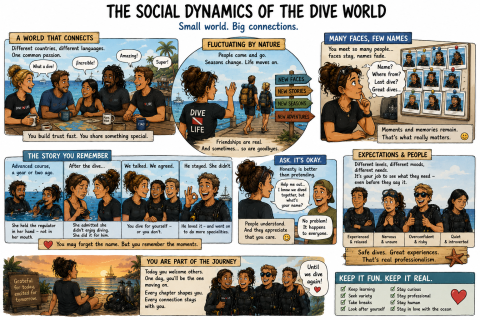
The dive world is small. And at the same time, constantly in motion. You work with people from different countries, with different backgrounds. On an average day, you hear several languages mixed together and work with guests and colleagues who otherwise would probably never have met. You quickly build a bond—often in just a few days. Diving together creates a form of trust that you rarely build so quickly in other situations. You share an experience that is exciting or special for many people, and that creates a connection.
But that same world is also fleeting. People come and go, seasons change, colleagues leave and new people join. You get used to someone you’ve worked closely with being gone a few weeks later. Friendships form quickly—and sometimes fade just as quickly, simply because everyone moves on. That’s part of it. And you have to be able to handle that.
Another typical aspect of this work is that you meet a lot of people, but get to know few of them really well. You see new faces every day, have conversations, share experiences, and guide people underwater. But often it’s just for those few days. Over time, a kind of recognition without context develops: you recognize faces, know you’ve dived together and maybe even where or when—but the name? That you forget.
It happens to everyone. Not because you’re uninterested, but simply because you work with so many people that it’s impossible to remember everything. Sometimes it happens the other way around: you recognize someone and suddenly a whole story comes back.
One day, a young man walked into the shop whom I immediately recognized. I didn’t remember his name, but I did remember the situation. I had done his Advanced course with him, about a year or two earlier. He was supposed to take the course with his girlfriend, but she dropped out after the first dive. I can still picture her: during that dive, she held her regulator in her hand the whole time. Not in her mouth—in her hand.
After the dive, I took her aside and said that I thought she wasn’t completely comfortable underwater yet. She then admitted, with tears in her eyes, that she actually didn’t like diving at all. She was only doing it for him—and didn’t want to disappoint him, but actually wanted to stop right away. That was deep. We talked with the three of us and eventually agreed that diving isn’t something you do for someone else. You do it for yourself—or you don’t do it at all.
I continued with him alone after that. He really enjoyed it and eventually did several specialty courses. When he came in again now, I remembered all of that. I even remembered that she was a doctor, that she was pregnant the following year, and that now they were traveling as a family for the first time. I also remembered how we had settled the finances at the time, to everyone’s satisfaction. The whole situation came back immediately—except for his name.
That’s exactly how it often works. You remember moments, situations, and conversations that make an impression, but names sometimes fade into the background. And that’s okay. The best way to deal with it is simple: be honest and don’t make it a big deal. “Help me out—I remember we dived together, but your name escapes me.” People understand that. In fact, they recognize it. Even if you only vaguely remember someone.
For them, you were the instructor who taught them to dive during that amazing holiday—often a once-in-a-lifetime experience. For you, they were one of the many you guided or trained: passersby in your daily work. Some you never see again, others keep coming back and you eventually get to know them better.
Another example. A guy messages me to say he’s coming back to the island and wants to dive with us again. I recognize his name immediately. So I do my homework and look him up in our schedule. I find two people with the same name, both about the same age, both in their early thirties, and both did an Open Water course with their girlfriend. I have memories of both: where they’re from, what they do, what they were like. But it starts to blur. Is this Joey from Brenda, the flight attendant? Or Joey from Rico’s sister, from that fitness clothing line?
I consult with a colleague. I say I’m just going to ask. My colleague says I really can’t do that and that I have to find out another way. I sleep on it and eventually decide to just ask. The answer: “I am—or was—Joey from Brenda, the flight attendant. But we’re no longer together. I’m coming now with Ilse, my new girlfriend.” We all had a good laugh about it later.
What’s often more important than the name is that you recognize someone and acknowledge that previous encounter. That makes someone feel seen.
At the same time, this dynamic also asks something of yourself. You have to learn to deal with the temporary nature of many contacts and with the fact that not every connection becomes a lasting friendship. It can’t. If you had to maintain a close bond with everyone you meet at work, 24 hours a day wouldn’t be enough.
For many dive professionals, this is precisely the charm of the job: the variety, the constant stream of new people, and the stories that come with it. It’s not unique to diving—anyone who works in tourism or hospitality recognizes this pattern. But in diving, it’s often more intense, because you experience something together that is special and personal for many people.
And in the end, you are also part of that movement. You’re not just the one who stays while others come and go—one day you move on too. Some people keep up this life for years, but for most it’s a phase: a few months, a few years. Almost always, it’s a period that stays with you, shapes you, and that you look back on with a certain nostalgia.
As a dive professional, you don’t just work with diving—you work with people. Every day. With different levels, expectations, and personalities. Some divers are relaxed and experienced. Others are insecure, tense, or even overconfident. It’s your job to see through that. To see what someone needs—even if that person can’t yet put it into words. That often starts before the dive: in the first conversations, during the briefing, in how someone behaves.
An important part of your job is managing expectations. Not making everything look better than it is. But being clear, honest, and positive. A good dive professional not only ensures a safe dive—but also a good experience. And those two are often more closely connected than you think.
es
Dinero y carrera
A menudo se idealiza el trabajo en la industria del buceo. Sol, mar, libertad. Las escuelas de buceo y los instructores disfrutan haciendo que la gente ajena a la industria sienta un poco de envidia y publican regularmente fotos de playas blancas y mares azul turquesa con frases como “Otro día en la oficina”. “Viviendo el sueño” es otro eslogan que a menudo se asocia al trabajo de instructor de buceo, no en menor medida por los propios divemasters e instructores. Participamos activamente en esa construcción de imagen. Para las escuelas de buceo, es marketing que debe hacer que los clientes deseen su próximo viaje de buceo. Para los profesionales del buceo, este tipo de imágenes y mensajes en sus redes sociales son la justificación ante familiares y amigos en casa de la elección poco convencional de este estilo de vida, una justificación que, al parecer, debe proclamarse regularmente con todo lujo de detalles.
Y esta imagen sí refleja nuestro trabajo. Pero es una imagen muy optimista, color de rosa, no una imagen completa. Quien se plantee seriamente una carrera en la industria del buceo debería desarrollar una visión más realista de la vida y el trabajo antes de empezar, de lo contrario corre el riesgo de decepcionarse. Quien tiene expectativas realistas está mejor preparado que quien persigue un sueño ingenuo.
Empecemos por lo que probablemente ya sabes: la mayoría de los profesionales del buceo no ganan un salario alto. Quien cambia una carrera como, por ejemplo, enfermero, maestro o vendedor por una vida como profesional del buceo bajo el sol, a menudo debe conformarse con la mitad o menos de la recompensa económica y también con muchas menos prestaciones sociales como seguridad social, pensión, etc. El trabajo de un profesional del buceo suele realizarse en países y regiones del mundo donde las condiciones laborales —especialmente para expatriados y trabajadores temporales extranjeros— son mucho más precarias que en los Países Bajos o Bélgica. Además, gran parte del trabajo en la industria del buceo también se realiza en la zona gris entre el trabajo oficial en el sector formal y el trabajo informal no declarado.
Los ingresos de un profesional del buceo suelen consistir en una combinación de una remuneración base, propinas, horas extra por ejemplo por una inmersión nocturna, y a veces comisión por cursos o ventas. Además, en muchos casos es un trabajo estacional. Eso significa que tus ingresos pueden fluctuar. Que a veces trabajas más por el mismo dinero. En muchos lugares del mundo se espera que estés disponible seis días a la semana durante la temporada alta. Y cuando la temporada termina, tu contrato también termina de inmediato.
Algunos instructores de buceo combinan su trabajo en la industria del buceo con otros trabajos estacionales, como el de instructor de esquí. Esto significa que tienes que mudarte dos veces al año: al terminar la temporada de invierno, de las montañas al mar, y al terminar la temporada de verano, al revés. Tuvimos durante un tiempo un instructor de los Países Bajos que dividía su año en 4-5 meses en Andorra (en los Pirineos) y 4-5 meses en Curazao, y entre medias visitaba a su familia en los Países Bajos o en Chile. Es una vida bonita e interesante cuando eres joven, pero normalmente no es algo que alguien pueda mantener toda la vida. Son raras las personas que pueden resistir toda la vida la tentación de establecerse en algún lugar. Una relación seria o tener hijos suele obligar a elegir más estabilidad y cambiar la vida libre de profesional del buceo por una alternativa más sólida.
Por cierto, hay diferencias de remuneración entre divemasters e instructores. Un divemaster guía y apoya. Un instructor imparte cursos y asume la responsabilidad final. Eso suele traducirse en más responsabilidad, más presión laboral, pero también más posibilidades de ganar dinero. Si “debes” convertirte en instructor depende de lo que busques. No todo el mundo quiere o necesita dar ese paso.
Una razón frecuente para no querer ser instructor es que los divemasters hacen inmersiones más bonitas que los instructores, o (todavía) no están dispuestos a asumir la responsabilidad de un instructor. Por otro lado, el trabajo de instructor suele ser más variado que el de divemaster: donde un DM solo puede guiar inmersiones, un instructor también puede formar a nuevos buceadores, hacer bautizos y seguir formándose para impartir diversos cursos. Al final, casi todos los que permanecen un tiempo en la industria del buceo acaban siendo instructores.
Lo importante es darse cuenta: no te harás rico. Pero puedes vivir una vida rica. En experiencias. En libertad. En los lugares a los que vas y las personas que conoces. Igualmente importante es la dinámica social del mundo del buceo.
The Dark Side of the Industry
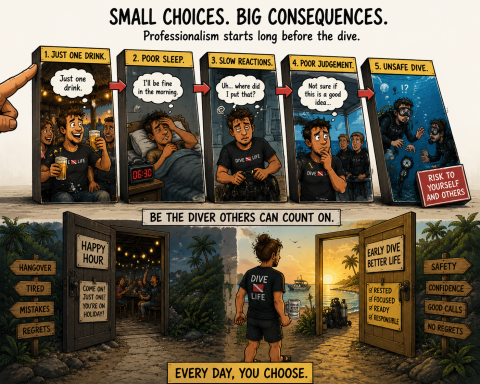
The diving world has a strong social side. People work together, but also eat, drink, and go out together. That makes the work fun and connecting. You get to know people quickly, build friendships, and share experiences that are special for many. At the same time, this social dynamic also brings risks. The line between work and free time easily blurs, the pressure to join in can be high, and it’s tempting to go along with habits that seem fun in the short term but are less innocent in the long run.
Alcohol often plays a role in this, but drug use also occurs in the industry—sometimes openly, sometimes more in the background. It’s important to be realistic about this. Not everyone deals with it the same way, but almost everyone encounters it sooner or later. What you do outside working hours directly affects how you function underwater. And underwater, you are responsible for others. That means you have to make choices and set boundaries—not because someone else says so, but because it is inextricably linked to professional behavior.
I want to be explicit here about drug use. Within the diving world—and more broadly within the tourism sector—there is sometimes a culture where drug use is normalized or even romanticized. It is presented as something that belongs, something you should try at least once, or something you can control as long as you do it “in moderation.” That image is not accurate. The reality is that drug use is not harmless for many people. It can lead to dependency, loss of control, and ultimately harm—to yourself and to others. You may not see it immediately, but it does happen. Anyone who looks around or asks will see how often things go wrong and how many lives are derailed by it.
You can tell yourself that you handle it wisely. That for you it’s just once, that you know your limits, and that you don’t suffer from it. Maybe that’s true. But even then, the question is what exactly you are normalizing by joining in. What culture you are maintaining, and what example you are setting for colleagues, trainees, and guests. As a dive professional, your responsibility goes beyond yourself. You work in an environment where safety is central, where people trust your judgment, and where your alertness can make the difference. That responsibility is not compatible with substance use that undermines your sharpness, judgment, or discipline—even if that effect is not always immediately visible.
There is another dimension that often remains out of sight. Drugs are illegal for a reason. Their production and distribution are accompanied by crime, exploitation, and violence. By participating—even in small or incidental ways—you contribute to a system that is harmful to many. That makes it neither a neutral nor a non-committal choice, but one with broader consequences.
What applies to drugs also largely applies to alcohol, although it is much more socially accepted. On a tropical island that is also a holiday destination, there is always a happy hour somewhere every evening and always a reason to celebrate. For guests, that’s part of their vacation. But if you live and work there, it’s different. What a holidaymaker can keep up for a week or two becomes simply unsustainable in the long run—financially, physically, and mentally. Anyone who finds themselves joining in every night and waking up with a hangover more and more often will sooner or later hit their own limits.
Setting boundaries in this context is not a restriction of your freedom, but rather a prerequisite for doing your job well and safely. It means consciously choosing what you do and don’t do, and taking responsibility for the role you have. That doesn’t make you less social, and it doesn’t make your work less fun—on the contrary.
In fact, it may be one of the most underestimated forms of professionalism. Saying no to alcohol or drugs at times when it would be easier to go along shows character, vision, and responsibility. Life is fun enough on the one hand and complicated enough on the other without drugs and excessive drinking. This is doubly true for a dive professional. Once you realize that, you really don’t have to think about it much longer.
Professionalism and Responsibility
As a dive professional, you are never just “a diver.” Your role goes beyond performing a dive or guiding a group underwater. You are simultaneously a guide, a point of contact, and a role model. People look at you—often without you realizing it. They observe how you behave, how you make decisions, how you respond to situations. And they imitate that behavior, sometimes consciously, but often unconsciously.
That means professionalism doesn’t end at the briefing or the moment you enter the water. It extends throughout your entire workday—and actually beyond that. How you interact with people, how you communicate, how you deal with fatigue, how you set boundaries: these are all signals that others pick up and incorporate into their own behavior.
Consistency is essential in this. Not being sharp occasionally, but consistently. Not only when it’s busy or when there is supervision, but especially at times when no one seems to be watching. That’s when you show who you really are as a professional.
You cannot be a safe dive leader if you do not guard your own boundaries. That applies physically—knowing when you are tired, when you need rest—but also mentally. It requires being honest with yourself about your own condition, alertness, and resilience. Sometimes that means taking a step back, skipping a dive, or asking for help. Those are not weak choices, but professional ones.
Professionalism rarely lies in big, visible moments. It is found in small, repeated decisions. Stopping on time instead of doing “one last dive.” Taking rest when needed, even if it’s inconvenient. Being honest about your own limits, even if that means adjusting expectations—of yourself or others.
It is precisely those seemingly small choices that, in the long run, make the difference between someone who can do the job well and sustainably, and someone who sooner or later hits their limits.
Physical Strain and Dive Fatigue
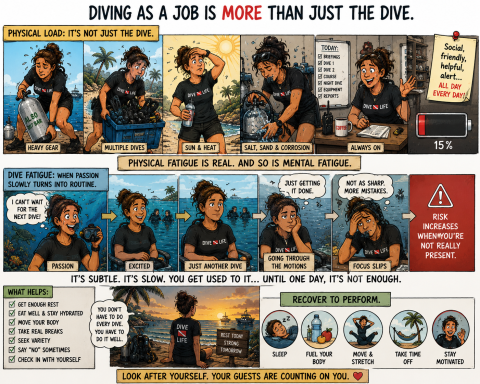
Diving as a job is physically demanding — often more than you initially realize. It's not just the dives themselves, but everything around them: multiple dives per day, lifting and moving equipment, working in the sun, dealing with salt water, and meanwhile staying alert to what's happening around you. And also being “on” all day — being social and cheerful. That physical strain is real, and those who don't take it into account will sooner or later hit their limits.
But just as important — and often less mentioned — is another form of fatigue: dive fatigue in the sense of mental saturation. At some point, you notice that your enthusiasm becomes less automatic. That you look forward to the next dive less. That it becomes something you do, instead of something you want to do. Not because something is wrong, but because repetition takes its toll. That is not failure. It's a logical consequence of something that was once special and has now become routine.
That's where the risk lies. Because where enjoyment and engagement decrease, your sharpness often decreases as well — not necessarily because you're physically tired, but because you're less mentally present. You do what you have to do, but less consciously. With less attention. And those are exactly the moments when small things get overlooked. Dive fatigue is rarely something that appears suddenly. It's subtle and creeping. You get used to it. You don't immediately recognize it as a problem, because everything still seems to be “just fine”. Until a situation demands just a bit more from you than you're willing or able to give at that moment.
That's why taking good care of yourself is about more than just physical recovery. It's also about guarding your motivation and engagement. Seeking variety, sometimes taking a step back, consciously choosing when you do and don't dive — these are not luxury choices, but part of sustainable professional functioning. You don't have to do every dive. You don't always have to say “yes”. In fact: knowing when not to do so is one of the most important skills you develop as a dive professional. Because ultimately, it's not just about being able to do the job — but about continuing to do it well, even in the long term.
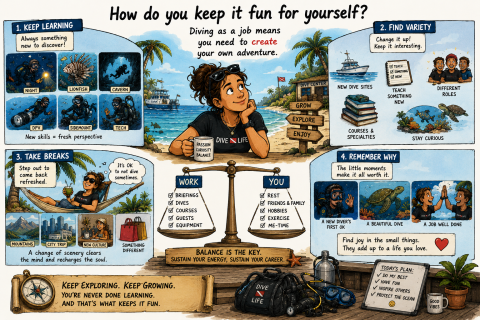
How do you keep it fun for yourself?
When diving becomes your job, your relationship with diving changes. What was once something special — something you looked forward to — becomes part of your daily routine. That’s inevitable. But it also means that enjoyment no longer comes automatically. You have to approach it more actively.
It starts with realizing that enjoyment in your work is not a given, but something that requires maintenance. Especially in a profession where repetition plays a big role. The same locations, the same briefings, the same exercises — day after day. What is new and exciting for one person is often the umpteenth time for you.
That’s why it’s important to find ways to keep it interesting for yourself. You can do this by seeking variety: discovering new dive sites, taking on different roles within your team, continuing to challenge yourself with courses or specialties, or simply by continuing to learn and staying curious about what happens underwater. Small changes can be enough to sharpen your perspective again.
I actually try to make sure I learn something new in diving every year. When I was a beginning instructor and had taught a number of Open Water and Advanced courses, I loved being able to broaden my expertise and also offer specialty courses. I started with night diving and deep diving, if I remember correctly. Shortly after, I earned my instructor certification for the lionfish course – something completely different from regular diving. Being able to pass that on to students was – and is – fantastic and a perfect change from the regular guided dives, introductory dives, and Open Water courses. In some of those specialties, I became an instructor right away; others I first learned as a student and gained the necessary experience before starting as an instructor. By now, I have more than 20 specialties, some of which have also become routine, but others still keep me sharp as an instructor.
At a certain point, I decided to take a cavern course, the first level of cave diving, simply because I was curious about cave diving. And also because it would make me a better sidemount diver. That was a special experience: my instructors (who knew I was an instructor) were tough and made me feel like a beginner again, with a steep learning curve ahead.
I can recommend everyone to do something like this: see what you can still learn in diving that you haven’t mastered yet. How fun is it to be a student again and learn something completely new? Knowing that it will make you a more versatile diver. Try something new. For example, diving with a full-face mask, or with a DPV, or see if you can take a technical diving course, or maybe a freediving course, or an ecology course. Even if you don’t immediately use it as a dive professional, it makes you a more complete diver and therefore a better instructor. I may already have more than 20 specialties, but I’m far from done learning! There’s always something new to discover.
But sometimes the answer lies in the opposite. Not diving for a while. Taking some distance. Allowing yourself not to be part of the daily routine. It’s both physically and mentally healthy to take a day or two off from diving after a busy week. And if you go on vacation (even those who live at a holiday destination need a vacation now and then), try to find a completely different environment: see if you can go into the mountains somewhere, or take a city trip with museums and/or shopping centers. There are probably plenty of options near you that fit your budget.
At first, that may feel contradictory — especially if diving was once your passion. But that distance can actually help you return with fresh energy. So you can see again what makes it so special. Enjoyment is not a given. But it is essential. Not just for yourself, but also for the people you work with. Enthusiasm is tangible. Just like the lack of it.
When diving becomes your job, you have to find enjoyment elsewhere — or relearn why you started in the first place. And sometimes that’s not a big insight, but something small: a beautiful dive, a successful course, or a moment when you see someone truly at ease underwater. Those are the moments that keep the work worthwhile.
Finally
In this chapter, we looked at what happens when diving becomes more than just a hobby. How your relationship with diving changes once it becomes your job. What the reality is of working in the dive industry — financially, practically, and socially. We reflected on working with people, on the dynamics of a world that is both small and constantly in motion, and on the less visible sides of the profession: responsibility, boundaries, fatigue, and taking care of yourself. And we looked at what it takes to sustain this work in the long term — and to not lose the joy in it.
Ultimately, working as a dive professional is not a job like any other. It is a way of life — with all the freedom and all the responsibility that comes with it. It is a life in which you see a lot, experience a lot, and meet many people. You go to places where others only come on vacation, you work in an environment that feels like a dream to many, and you share experiences daily that are exceptional for other people. But that same environment also demands something from you. It requires you to be present, to stay sharp, to take responsibility — even at times when you might not feel like it.
It is also a life in which you are constantly making choices. About how you work, how you interact with people, how you take care of yourself. About when to continue and when to stop. About what you accept and where you draw your line. Often small choices. But choices that add up and ultimately determine how you experience this work — and how long you can keep it up.
Some people stay in it. For them, it becomes a lifelong path. For others, it is a phase — a period of a few months or a few years, which then makes way for something else. But for almost everyone, one thing is true: it does not leave you untouched. It shapes you. It sharpens you. And it teaches you something — not just about diving, but also about yourself.
You learn to deal with responsibility, with freedom, with people, with boundaries. You learn when to keep going, and when it is better to take a step back. You learn that joy is not a given, but something you have to actively seek and protect. And maybe that is ultimately the core of this profession. Not how well you dive. Not how many dives you have made. Not how many courses you have taught. But how you deal with everything around it. How you do your work when no one is watching. How you make choices when it would be easier not to. And how you make sure you do it well not just today — but also tomorrow, and a year from now, and even longer after that.
