


Just air?
From outdoor air to breathing air in your diving cylinder
Just air
During introductory dives, I almost always tell new divers the same thing: a scuba tank does not contain oxygen, nor does it contain some special breathing gas. It simply contains air. The same air we breathe here at the surface and have been breathing all our lives. Nothing special. The only unusual thing is that we have compressed a very large amount of it into a relatively small cylinder. That often reassures people. And essentially, it is true.
But at the same time, this seriously understates the work that goes on at a filling station. Because there is a lot more involved than simply compressing air into a cylinder. It requires specialized and fairly expensive equipment: not just a compressor, but also a range of additional equipment to ensure that the air is ultimately suitable for breathing underwater.
Quite a lot happens between the ambient air drawn in by a compressor and the breathing air that eventually ends up in your scuba cylinder at high pressure. The air has to be compressed in several stages, cooled between those stages, have water and oil removed, and finally pass through a filtration system. Throughout this process, we have to prevent contaminants from the surrounding environment or from the compression process itself from entering the breathing air. And after all that, we still need to be able to verify that the final product is actually clean enough to breathe underwater.
So yes, filling a scuba cylinder is essentially just putting a lot of ordinary air into a cylinder.
What is air, actually?
Our entire lives take place in air. From our first breath shortly after birth to our very last, we are constantly surrounded by it. We move in it, work in it, sleep in it, and breathe it in and out every few seconds. Precisely because air is always and everywhere around us, we rarely stop to think about it.
Diving is one of the exceptions. As soon as we descend beneath the surface, we leave the environment in which our bodies normally function. Suddenly, we have to bring the air we need with us. The same applies, even more extremely, to space travel. Underwater and in space, something we take completely for granted at the surface suddenly becomes a basic necessity of life that has to be provided through technology. But what exactly is air?
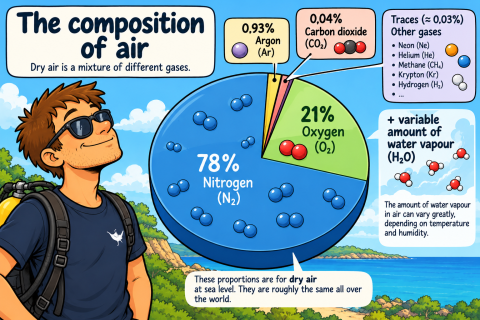
Air is not a single substance, but a mixture of different gases. If we leave water vapour aside, ordinary dry air consists of approximately 78% nitrogen and 21% oxygen. The small amount that remains consists mainly of argon, together with around 0.04% carbon dioxide (CO₂) and traces of other gases. This may make it sound as though air is the same everywhere. And for its main components, surprisingly, that is more or less true. The ratio of nitrogen to oxygen does not suddenly change because you are standing in Curaçao, the Netherlands, or high in the mountains.
But air is never just that neat list of gases from a chemistry textbook. Outdoor air also contains water vapour, and the amount can vary enormously. The warmer the air, the more water vapour it can contain. In warm, humid tropical regions such as the Caribbean, the Amazon and Southeast Asia, water vapour can therefore make up several percent of the air. In desert regions, such as around the Red Sea in Egypt and Saudi Arabia, relative humidity is generally much lower. Even so, hot desert air can still contain a considerable amount of water vapour in absolute terms. Conversely, extremely cold polar air can have a relative humidity of 100% while still containing much less water than warm desert air. The colder the air, the less water vapour is needed for it to become saturated.
Outdoor air also contains all kinds of tiny particles and substances that depend strongly on the surrounding environment. We often notice this without really thinking about it. Air by the sea smells different from air in a forest, and the air in the middle of a busy city smells different again. Sea air, for example, contains microscopic droplets and salt particles carried into the air by waves and sea spray. The characteristic smell of the sea, incidentally, does not come from the salt itself, but mainly from volatile substances produced in and around the ocean. In a forest, we find pollen, dust and various organic compounds released by plants and trees. In urban and industrial areas, very different substances may be added. Exhaust fumes, smoke and combustion processes release particulate matter, nitrogen oxides and carbon monoxide, among other pollutants. Under certain conditions, these pollutants can combine to form what we call smog. Solvents, paints, fuels and other chemicals can also release volatile substances into the surrounding air.
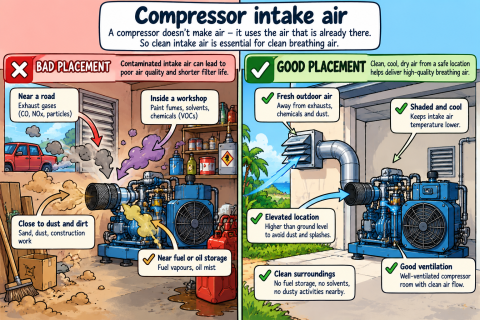
So although air everywhere consists largely of the same mixture of nitrogen and oxygen, that does not mean that all outdoor air is equally clean. And for a compressor, that matters a great deal. A compressor does not make air. It uses the air that is already there. Good breathing air therefore does not begin with the compressor, but with the air the compressor takes in.
What is a dive compressor?
To compress air, you need a compressor. Put simply, this is a machine that draws in air and then compresses it into an increasingly smaller volume, causing the pressure to rise. In other words, the air particles, or gas molecules, are pushed closer and closer together.
We encounter compressors everywhere. In a garage, compressed air is used to power tools and inflate tyres. Refrigerators and air-conditioning systems have compressors, and compressors also play an important role in all kinds of industrial processes. The basic principle is always the same: a gas is compressed so that its pressure increases. A dive compressor essentially does the same thing, but takes the process considerably further. An ordinary compressor from your local hardware store will typically produce a pressure of around 8 to 10 bar. Heavier workshop compressors may produce 10 to 15 bar. That is more than enough for a car tyre or pneumatic tools, but it does not get us very far as divers. We need much higher pressure.
The air around us is at a pressure of approximately 1 bar at sea level. A scuba cylinder is usually filled to 200 bar, while some cylinders and storage systems operate at 300 bar or slightly more. To get an idea of what that means: at 200 bar, very simply put, we have compressed approximately 200 litres of ambient air into a volume of one litre. An 11-litre scuba cylinder filled to 200 bar therefore contains roughly 2,200 litres of air, measured at normal atmospheric pressure.
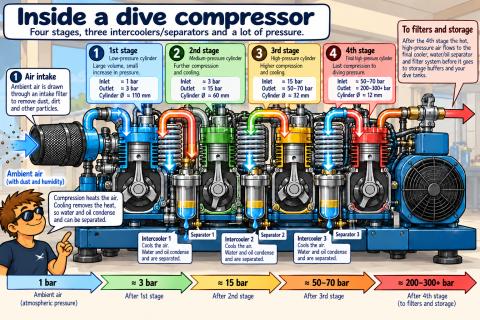
That does not mean that a compressor simply pumps out air at a pressure of 200 or 300 bar. The air is compressed step by step. In a typical high-pressure compressor for scuba cylinders, this happens in three, four or sometimes more compression stages. Each stage essentially involves the same process. A quantity of air is drawn into a cylinder, a piston then reduces the available space, and the compressed air is passed on to the next stage. There, the same air is compressed again into a smaller volume, causing its pressure to rise further.
This does not happen all at once, and there are good reasons for that. Air becomes hot when it is compressed. At the same time, the ambient air drawn into the compressor contains water vapour, some of which condenses during the compression and cooling process. The air is therefore cooled between the different compression stages and condensate is separated out.
A dive compressor is therefore not a single pump that takes air directly from 1 bar to 200 or 300 bar. It is better thought of as a chain of successive compression stages in which the pressure is gradually increased while the air is cooled and treated in between. A compressor therefore consists of several ‘stages’, with cylinders and pistons that become progressively smaller. After each stage, the same amount of air occupies less volume. As a result, less and less space is needed to compress that air further.
In a typical four-stage high-pressure compressor, the cylinder of the first stage might, for example, have a diameter of around 110 mm. This first stage takes the incoming ambient air from approximately 1 bar to around 3 bar. The air then flows through cooling tubes, where some of the heat generated during compression is removed. The second cylinder is already considerably smaller, perhaps around 60 mm in diameter, and compresses the air further to approximately 15 bar. The air is then cooled again and condensate is separated. The third stage is smaller still — perhaps 32 mm — and raises the pressure further to around 50–70 bar. Again, the air is cooled and condensate is separated before it enters the final stage.
Only in the fourth stage, where the cylinder in this example is just around 12 mm in diameter, is the air compressed to its final pressure of 200, 300 bar or slightly higher. This is followed by final cooling and another separation of condensate. In this way, the same amount of air is compressed further and further in four stages using progressively smaller cylinders. This is no coincidence. As the pressure rises, the volume occupied by the same amount of air continues to decrease. Each successive stage therefore has to handle a much smaller volume of air than the previous one.
| Compression | 1 bar → ±3 bar | ±3 bar → ±15 bar | ±15 bar → ±50–70 bar | ±50–70 bar → 200–300+ bar |
| Cylinders | 110 mm | 60 mm | 32 mm | 12 mm |
The condensate discharged by the separators is not clean water, incidentally. In an oil-lubricated compressor, it contains not only the water that was originally present as water vapour in the ambient air, but also small amounts of compressor oil. The result is an oily condensate that must be collected separately and disposed of appropriately.
You may also recognise the word ‘stages’ from your regulator, which has a first and a second stage. There, however, exactly the opposite happens. While the different stages of a compressor progressively increase the pressure, the two stages of your regulator reduce that high pressure back to ambient pressure. The first stage is the part connected to the valve of your scuba cylinder. It reduces a cylinder pressure of, for example, 200 bar to an intermediate pressure of approximately 8 to 10 bar above ambient pressure. The second stage — the part with the mouthpiece that you breathe from — then reduces this intermediate pressure further to ambient pressure. That ambient pressure, of course, depends on your diving depth. At the surface it is approximately 1 bar, at 10 metres around 2 bar, and at 20 metres around 3 bar. Your regulator adjusts accordingly and supplies air at approximately the same pressure as the water surrounding you at that moment.
In a sense, a compressor and a regulator therefore do exactly the opposite: the compressor raises air in several stages from an ambient pressure of approximately 1 bar to 200–300 bar, while the regulator reduces that pressure in two stages from 200 (or 300) bar back to ambient pressure.
What does the compressor draw in?
As we saw earlier, a compressor does not make air. It draws in air from its surroundings and compresses it. This means that breathing-air quality does not begin at the filtration system. Good breathing air starts with good intake air.
Before ambient air enters the compressor, it first passes through an intake filter. This is primarily a particle filter: it captures dust, sand, pollen and other small solid particles that we do not want inside the compressor. In dusty or salty environments, such a filter is important not only for air quality but also for the service life of the compressor itself.
However, an intake filter does not turn contaminated ambient air into clean air. Gaseous contaminants such as carbon monoxide (CO), carbon dioxide (CO₂), and vapours from fuels, paints or solvents can simply pass through it. That is why the location from which the compressor draws its air remains so important. An air intake should not, for example, be positioned next to the exhaust of a car, truck or diesel generator. Smoke, paint, solvents, fuels, cleaning products and other volatile substances should also be kept as far away from the intake as possible.
Combustion gases pose a particular risk. They may contain carbon monoxide (CO), a colourless and odourless gas that can be dangerous even at very low concentrations. If a running generator, car engine or other combustion engine is located near the air intake, the compressor can simply draw those exhaust gases in. Exhaust from another machine or a poorly ventilated compressor room can also affect the quality of the intake air. After all, a compressor continuously moves large quantities of air. Something that appears harmless at some distance may therefore still reach the intake. A filter downstream of the compressor is not a licence to draw in poor-quality air. Filters can do a great deal, but not everything, and their capacity is limited. The cleaner the air entering the system at the beginning of the process, the easier it is to produce reliable breathing air at the end.
There are also systems that treat the intake air before it enters the compressor. A standard intake filter mainly removes dust, sand, pollen and other solid particles, but much more specialised systems also exist. Some systems, for example, reduce the CO₂ concentration of the intake air before it is compressed. Others use UV light to inactivate microorganisms such as bacteria, viruses and fungi in the incoming air. Such systems can be useful when local conditions make it difficult to obtain sufficiently clean intake air. The principle is interesting: instead of trying to remove an unwanted substance from the compressed air at the very end of the process, you address the problem before the air even enters the compressor. But even these systems do not change the basic principle: the cleaner the air you draw in, the better.
Pollution is not the only factor. Temperature and humidity also have a major influence on the work that a compressor and its filtration system have to perform. We notice this particularly in a tropical climate such as Curaçao. Warm air can contain a great deal of water vapour, and a compressor draws in hundreds of litres of that air every minute. Initially, all of that water simply enters the compressor along with the air.
During compression, the air becomes hot, and when it is subsequently cooled, some of that water vapour condenses into liquid water. The warmer and more humid the intake air, the more water the system ultimately has to separate and the greater the load on the drying and filtration system. So for a filling station, it certainly matters where the compressor is located and where its air intake is positioned. Geplakte markdown
Heat and water
Anyone who watches a compressor run for a while will quickly notice two things: it gets hot, and a surprising amount of water comes out of it. That may seem strange. After all, we are only putting air into the machine. So where do all that heat and water come from? And why does air become hot when we compress it?
When we compress air, we force the gas molecules closer and closer together. Doing so requires work. Part of that energy ends up as heat in the gas, causing the temperature of the air to rise sharply during compression. You can experience the same principle at home. If you use a bicycle pump to inflate a tyre quickly, the pump becomes warm. A dive compressor essentially does the same thing, but continuously and at much higher pressures.
That is why the air is cooled again after each compression stage. The hot compressed air flows through cooling tubes or intercoolers, while a fan blows ambient air across them to remove much of the heat. After the final compression stage, the same thing happens in the aftercooler or final cooler.
Cooling is important not only for the compressor. It also has a second effect: condensation. The water that comes out of a compressor is not produced by the compressor. It was already present in the intake air — not as liquid water, but as invisible water vapour. As we saw earlier, warm air can contain much more water vapour than cold air. As air cools, it may therefore reach a point at which it can no longer hold all of the water vapour present in gaseous form. The air becomes saturated.
The temperature at which this happens is called the dew point. If the air cools below its dew point, water vapour begins to condense into tiny droplets of liquid water. The same thing happens when dew forms on grass in the morning, when moisture appears on the outside of a cold glass, or when a mirror fogs up while you are taking a shower. The water does not appear from nowhere: it was already present in the air as water vapour.
Exactly the same thing happens inside a compressor, but on a much larger scale. The compressor continuously draws in large quantities of ambient air. In a warm and humid climate, every cubic metre of that air contains a considerable amount of water. During compression, the air becomes hot and is then repeatedly cooled between the compression stages. Each time this happens, some of the water vapour condenses.
The condensate separators remove the resulting liquid water from the airflow. In an oil-lubricated compressor, a small amount of compressor oil also ends up in the condensate, so the discharged liquid is an oil-water mixture. Even so, cooling and separation do not remove all of the water from the air. After the final separator, the compressed air still contains water vapour. And it is precisely this remaining moisture that becomes important in the next step: drying and filtering our breathing air.
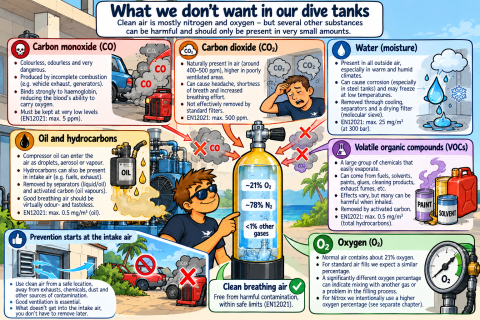
What should not be in your cylinder?
We have already seen that the ambient air drawn in by a compressor can contain a considerable amount of water and that we need to remove as much of this moisture as possible during and after compression. But water is not the only thing we would rather not find in our final breathing air. Other substances can also enter the compressed air through the ambient air or during the compression process itself. These include carbon monoxide, elevated concentrations of carbon dioxide, oil and volatile organic compounds. Some of these are undesirable even in very small quantities, especially when we breathe them under pressure and at depth.
This does not mean that breathing air has to be chemically pure. That would be impossible. As we saw at the beginning, air itself is already a mixture of different gases, and ambient air always contains small amounts of other substances. What matters is which substances are present and at what concentrations. So let us first look at the most important substances that we do not want — or want only in very small amounts — in our scuba cylinders.
Carbon monoxide (CO)
Carbon monoxide is one of the most dangerous contaminants that can enter breathing air. The gas is colourless and odourless and is produced by incomplete combustion. Exhaust gases from cars, generators and other combustion engines are therefore important potential sources. CO is dangerous because it binds to haemoglobin in the blood much more strongly than oxygen does. This reduces the blood’s ability to transport oxygen.
For a diver, this is particularly dangerous. Underwater, the partial pressure of a gas increases with ambient pressure. A contaminant that is present at only a very low concentration at the surface is therefore breathed at a higher partial pressure at depth. The best defence against CO is therefore, first and foremost, to prevent it from being drawn into the compressor. A good location for the air intake is essential. Some filtration systems also contain a catalyst, such as hopcalite, which can convert CO into CO₂.
Carbon dioxide (CO₂)
Carbon dioxide occurs naturally in ambient air and is produced by processes including respiration and combustion. In open outdoor air, its concentration is normally a few hundred parts per million (ppm), but in poorly ventilated spaces this concentration can rise considerably. CO₂ is a normal part of our breathing process: our bodies produce it continuously and we exhale it again. However, an elevated concentration in the air we breathe makes it more difficult for the body to eliminate CO₂. This can lead to headaches, shortness of breath, increased breathing rate and, eventually, more serious symptoms.
For divers, CO₂ is particularly important because exertion, high breathing resistance and inadequate ventilation of the lungs can already contribute to CO₂ buildup in the body. We therefore do not want to start with an elevated concentration in our breathing air as well. A standard breathing-air filter does not necessarily remove CO₂ effectively. If a compressor draws in air with an elevated CO₂ concentration, this may therefore also be reflected in the breathing air it produces. Good ventilation and the location of the air intake are once again important. In situations where the intake air consistently contains too much CO₂, specialised systems are available to remove CO₂ either before or after compression.
Water (moisture)
Water should also be present only in very limited quantities in breathing air. Moisture inside a scuba cylinder can cause corrosion over time, particularly in steel cylinders. Water can also dissolve or carry other contaminants and promote chemical reactions. It is therefore not only undesirable in itself, but can also contribute to other forms of contamination and deterioration. At very low temperatures, water can also freeze and cause problems in valves and regulators. This is particularly relevant when compressed air cools rapidly as it expands. That is why so much attention is paid to cooling, condensate separation and drying throughout the compression process. The molecular sieve in the final filter removes much of the remaining water vapour.
Oil and hydrocarbons
Many high-pressure compressors are lubricated with oil. Obviously, that oil should not end up in the breathing air in any significant quantity. During compression, very small amounts of oil can be carried along with the airflow as droplets, aerosols or vapour. Hydrocarbons may also already be present in the intake air, for example from fuels, solvents or exhaust fumes. Separators remove liquid oil and aerosols, while activated carbon plays an important role in removing oil vapours and other organic compounds. Good breathing air should ultimately be virtually odourless and tasteless. A noticeable oily or chemical smell or taste is therefore always a reason to question the quality of the air.
Oxygen
The oxygen content itself is also an important parameter. Normal ambient air contains approximately 21% oxygen. We therefore expect roughly the same proportion in ordinary compressed air. A clearly different oxygen percentage may indicate that the air has been mixed with another gas or that something in the production or filling process has not happened as intended. With Nitrox, of course, we deliberately increase the oxygen percentage. But that is another subject, which we will return to in a separate chapter.
VOCs
Finally, air can contain all kinds of volatile organic compounds, commonly referred to by the abbreviation VOCs. This is not one particular substance, but a large group of compounds that evaporate easily. They may come from sources such as petrol and diesel, paints, adhesives, cleaning products and solvents. Which VOCs may be present and how harmful they are varies considerably. Once again, the first line of defence is simple: make sure the compressor draws in the cleanest possible ambient air. Activated carbon can adsorb many organic vapours, but here too, a filter is not a licence to draw in contaminated air. Ultimately, the same principle always applies: what does not enter the intake air does not have to be removed later.
From compressed air to breathing air
We now know which substances we would rather not find in our scuba cylinders. Some of them can be kept out of the compressor by ensuring that the intake air is clean. Others are already removed during compression as the air is cooled and condensate is separated. But that is not enough. After the final compression stage, the compressed air still contains water vapour and may contain small amounts of oil vapour and other contaminants. Before we can store this air in our cylinders as breathing air, it therefore needs further treatment. For this, we use a specialised filtration system. Geplakte markdown
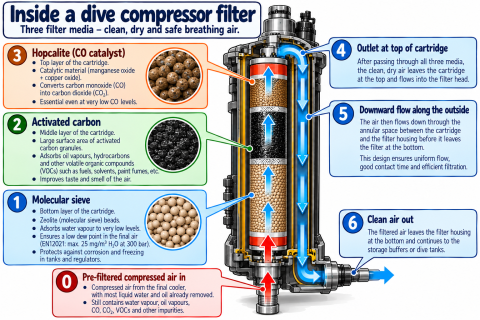
Molecular sieve
One of the most important materials in a breathing-air filter is a molecular sieve. This usually consists of zeolite: a hard, crystalline material composed mainly of silicon, aluminium and oxygen. In a filter cartridge, it usually looks like small granules or beads. What makes it special is on the inside. Zeolite has a crystalline structure containing an enormous network of microscopic pores and channels. As a result, a handful of these granules actually has a surprisingly large internal surface area to which water molecules can attach.
This process is called adsorption. It sounds similar to absorption, but there is an important difference. In absorption, one substance is taken up into another material, like water into a sponge. In adsorption, molecules attach themselves to the surface of a material. In this way, a molecular sieve removes the remaining water vapour from the compressed air and reduces the moisture content far beyond what cooling and mechanical separation alone can achieve.
Activated carbon
A second commonly used filter material is activated carbon. Because of its microscopic structure, this material also has an enormous internal surface area. Activated carbon adsorbs oil vapours and many kinds of organic compounds. In doing so, it helps remove not only harmful substances but also unwanted odours and tastes from the breathing air.
The latter is something divers can easily recognise. Good breathing air should essentially have no smell or taste at all. If you clearly taste or smell oil, exhaust fumes or a chemical odour during a dive, that is a sign that something may be wrong.
Catalyst
Some filtration systems also contain a catalyst, such as hopcalite. This material, a brownish-black mixture of manganese and copper oxides that looks somewhat like coarsely ground coffee, is used to convert carbon monoxide (CO) into carbon dioxide (CO₂). A catalyst accelerates a chemical reaction without itself being consumed in the process. In this case, carbon monoxide reacts with oxygen to form carbon dioxide:
2 CO + O₂ → 2 CO₂
This may sound strange — after all, we do not want excessive concentrations of CO₂ in our breathing air either — but carbon monoxide is particularly dangerous even at very low concentrations. Converting it to CO₂ makes it possible to greatly reduce the CO concentration. Such a catalyst also works properly only under the right conditions. Moisture is particularly important: too much water vapour can significantly reduce its effectiveness. This is another reason why the air must first be properly dried.
None of these materials will continue working indefinitely. A molecular sieve eventually becomes saturated with water. Activated carbon becomes loaded with the substances that bind to it. The effectiveness of a catalyst also depends on the conditions under which it is used. Filter cartridges therefore have a limited service life. How long they last depends on factors including the amount of air flowing through them, the temperature of the compressed air and, above all, the amount of moisture the filter has to process. This also explains why good cooling and water separation before the filter are so important. Every drop of water that can be removed earlier in the system no longer has to be captured by the filter material.
It is tempting to think of the filtration system as the component that automatically turns any kind of compressed air into clean breathing air. That is not how it works. A filter is not a magic box. It can remove only what it was designed to remove, and only for as long as the filter material has sufficient capacity remaining. Some contaminants are hardly removed at all — or not removed at all — by a standard filter cartridge. Good breathing air therefore begins much earlier in the process: with clean intake air, a well-maintained compressor, effective cooling and condensate separation, and filter material that is replaced on time.
The filtration system is therefore a crucial final stage in air treatment. But it cannot repair something that has fundamentally gone wrong earlier in the process. A professional filling station therefore does not rely on a single filter. The air is treated in several stages, with each stage addressing a different problem. First, dust and other solid particles are kept out of the intake air. During and after compression, liquid water and oil are separated. In more extensive installations, the compressed air may then be cooled and dried further using refrigerated dryers, allowing even more water to condense and be drained away. Filter materials such as molecular sieve and activated carbon then remove the remaining water vapour, oil vapours and other contaminants. Additional filters or catalysts may be used for specific substances. The principle is always the same: remove each contaminant as early and as efficiently as possible, so that the next stage has as little work to do as possible.
From a linguistic point of view, it is interesting that for convenience we refer to all these different processes as filtering. Technically, however, many different things are happening. Dust and other solid particles are trapped. Droplets of water and oil are separated. Water vapour and organic compounds are adsorbed onto materials such as molecular sieve and activated carbon. And some substances can even be chemically converted with the help of a catalyst. Filtering is therefore a surprisingly simple word for a whole range of different physical and chemical processes. Each technique addresses a different problem. A water droplet requires a different approach from water vapour, and a particle of dust behaves very differently from a molecule of carbon monoxide. That is precisely why a good breathing-air system usually consists of several different stages.
When is air actually ‘breathing air’?
In the previous two sections, we looked at which substances we would rather not find in our breathing air and how we filter them out. That does not mean that breathing air has to be chemically completely pure. That would be impossible. Even clean ambient air contains carbon dioxide and water vapour, for example, and even after compression and filtration, very small amounts of oil, hydrocarbons or other contaminants may remain. The question, therefore, is not only what is in the air, but above all how much. Or, put more simply: how clean is clean enough?
Standards exist for exactly this purpose. They specify the requirements that compressed air must meet before we can use it as breathing air. Among other things, they look at oxygen content and the maximum permitted amounts of carbon monoxide, carbon dioxide, water and oil.
Interestingly, there is no single universal worldwide standard for this. In Europe, EN 12021 is widely used, while in the United States, CGA Grade E is an important reference for diving breathing air. Canada uses CSA Z180.1, and Australia and New Zealand use AS/NZS 2299.1. China has its own national standard, GB 18435-2007, specifically covering breathing gases for divers. Many smaller countries do not have their own separate standard for diving breathing air and, in practice, follow one of these larger standards or adopt similar requirements.
The values are expressed as percentages, ppm and mg/m³. The unit ppm stands for parts per million: the number of parts of a particular substance per million parts of air. A concentration of 5 ppm CO therefore means that for every million gas molecules, approximately five molecules of carbon monoxide are present. mg/m³, on the other hand, indicates how many milligrams of a substance are present in one cubic metre of air.
| Standard | EN 12021 | CGA Grade E | CSA Z180.1 | GB 18435-2007 | AS/NZS 2299.1 |
| O₂ | 20–22% | 20–22% | 20–22% | 20–22% | 20–22% |
| CO₂ | ≤ 500 ppm | ≤ 1,000 ppm | ≤ 600 ppm | ≤ 500 ppm | ≤ 600 ppm |
| CO | ≤ 5 ppm | ≤ 10 ppm | ≤ 5 ppm | ≤ 10 ppm | ≤ 5 ppm |
| H₂O | ≤ 25 mg/m³ | ≤ 24 ppm* | ≤ 34 ppm* | dew point ≤ −21 °C | ≤ 50 mg/m³ |
| Oil | ≤ 0.5 mg/m³ | ≤ 5 mg/m³ | ≤ 1 mg/m³ | ≤ 5 mg/m³** | ≤ 0.5 mg/m³ |
| THC | — | ≤ 25 ppm | ≤ 10 ppm*** | — | — |
| Odour | None | None | Slight | None | None |
Perhaps the first thing that stands out in this table is how much the standards have in common. For oxygen content, all five are practically identical: normal breathing air should contain approximately 21% oxygen. They also all agree that carbon monoxide and carbon dioxide should be present only in very low concentrations.
Nevertheless, the limits are not set at exactly the same levels everywhere. For carbon monoxide, for example, EN 12021 allows a maximum of 5 ppm, while CGA Grade E and the Chinese standard allow 10 ppm. For carbon dioxide, the limit ranges from 500 ppm in Europe and China to 1,000 ppm under CGA Grade E. There are also considerable differences for oil: from 0.5 mg/m³ in Europe and Australia/New Zealand to 5 mg/m³ in the American standard. The Chinese limit of 5 mg/m³ is not entirely directly comparable, because it combines oil mist and particulates.
Standards also differ in the way they address contaminants. The American and Canadian standards, for example, specify a separate limit for THC, or Total Hydrocarbons. Such substances may originate from sources including oil and fuel vapours. Benzene, which occurs in petrol vapour, is an example of a hydrocarbon that we obviously do not want in our breathing air. The European, Chinese and Australian/New Zealand values in this comparison do not include a separate THC limit for ordinary breathing air. That does not mean that hydrocarbons are irrelevant under those standards, but rather that different standards use different ways of specifying air quality.
Comparing water limits is even more complicated. Moisture can be expressed as a concentration in ppm or mg/m³, but also as a dew point. The Chinese standard, for example, uses the latter and requires a dew point of no higher than −21 °C.
In short, there is no magic number below which compressed air suddenly becomes ‘breathing air’. The exact limits vary between standards, and sometimes the methods used to specify contaminants differ as well. But the basic principle is the same everywhere: the air must contain sufficient oxygen while also being clean and dry enough to breathe safely. A standard therefore tells us how clean our breathing air needs to be. But that still does not tell us how clean the air coming from our own compressor actually is. For that, we need to measure.
Trust is good, measuring is better
As a diver, you are probably already familiar with an oxygen analyser. Anyone who has dived with Nitrox has probably used one to check the oxygen percentage in a cylinder before a dive. Measuring equipment also exists for the other substances we want to monitor in breathing air. This can be done in several ways.
The most comprehensive check is a laboratory analysis. A sample of the produced breathing air is taken and analysed by a specialised laboratory. This makes it possible to determine very accurately how much CO, CO₂, water, oil and other contaminants the air contains. Such an analysis provides a reliable picture of the air quality at the time the sample was taken.
But that immediately reveals a limitation as well. A laboratory analysis is a snapshot. If the air is excellent today, that does not automatically mean that it will still be excellent next week, or that it was last week. A filter gradually becomes saturated, a compressor can wear, and the quality of the ambient air being drawn in can change. A generator that was not next to the air intake yesterday might suddenly be there tomorrow.
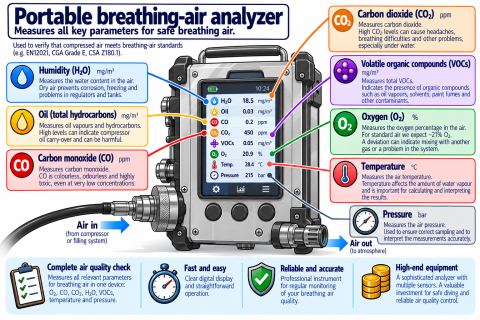
That is why filling stations also check air quality themselves, either regularly or even continuously. Sensors and analysers are available for oxygen (O₂), carbon monoxide (CO), carbon dioxide (CO₂) and moisture, among other parameters. More advanced systems may also measure VOCs, for example. Air-quality measuring equipment is often quite expensive, ranging from a few hundred euros or dollars for a device that measures only oxygen, to several thousand euros or dollars for a professional combined analyser that measures several of these parameters simultaneously, and more than ten thousand euros or dollars for a continuous breathing-air quality monitor.
Such a monitoring system can reveal changes much faster than periodic laboratory analysis. If the CO concentration suddenly begins to rise, or the air leaving the filtration system becomes increasingly humid, this indicates that something is changing somewhere. Perhaps contaminated ambient air is being drawn in, a separator is no longer functioning properly, or a filter cartridge is beginning to become saturated.
The two methods therefore complement each other well. A laboratory analysis can periodically — for example, quarterly — provide a comprehensive check that the produced breathing air complies with the applicable standard. Regular or continuous measurements can meanwhile monitor whether important values change between those analyses. In addition, the two methods provide a useful check on each other. A laboratory analysis can confirm that the station’s own measuring equipment is producing reliable readings, while regular or continuous monitoring can show whether air quality remains stable between two laboratory analyses.
This measuring equipment usually contains several sensors, each of which measures a particular substance in its own way. Electrochemical sensors, for example, are often used for oxygen (O₂) and carbon monoxide (CO), while carbon dioxide (CO₂) is usually measured using infrared light. Moisture can be measured with a sensor that responds to water molecules, while VOCs can, for example, be detected using a Photoionization Detector (PID). A professional breathing-air analyser is therefore essentially a collection of small, specialised measuring instruments combined in a single device. Each sensor has its own accuracy and service life and may begin to drift or become depleted over time. Sensors therefore need to be checked regularly and calibrated or replaced when necessary.
This leads to an important principle for every filling station: you should not simply trust your compressor and filters. You also need to verify that they are actually doing what you think they are doing. And ultimately, the same applies to the measuring equipment itself. Trust is good. Measuring is better. But only if you can trust the measurement.
Buffer tanks and cascading
A scuba cylinder contains a surprising amount of air. A typical 11-litre cylinder filled to 200 bar contains the equivalent of approximately 2,200 litres of air. And at a busy dive centre, dozens of these cylinders may need to be filled one after another. That is why we usually do not fill scuba cylinders directly from the compressor, but from a buffer bank.
A compressor cannot produce that amount of air at the same rate at which we need it during filling. A compressor producing 300 litres per minute, for example, produces approximately 18,000 litres of free air per hour; a 450-litre-per-minute machine produces around 27,000 litres. Yet a filling station can deliver much more air to a whole row of scuba cylinders in a short period of time. This is possible because the compressor and filling panel usually do not work directly with each other. The breathing air produced by the compressor is first stored at high pressure in buffer tanks: large high-pressure cylinders that together form a reserve of breathing air.
Buffer tanks solve an important practical problem. A compressor produces air slowly but steadily, whereas a dive centre tends to consume that air in peaks. There may be hardly any filling for an hour, followed by twenty or thirty empty cylinders suddenly arriving at once. While things are quiet, the compressor can fill the buffer tanks. When the cylinders arrive, that stored air can then be delivered much more quickly.
Buffer tanks therefore separate production from consumption. The compressor does not have to start every time someone wants to fill a single cylinder, and the speed at which cylinders can be filled is no longer determined solely by the amount of air the compressor is producing at that particular moment. The difference can be considerable. A compressor producing 450 litres per minute produces approximately 27,000 litres of free air in an hour. In a buffer system, that air can be accumulated over a longer period and then made available to the filling panel in a much shorter time. The compressor may have spent hours building up a large reserve; the divers who come to fill their cylinders in the afternoon hardly notice.
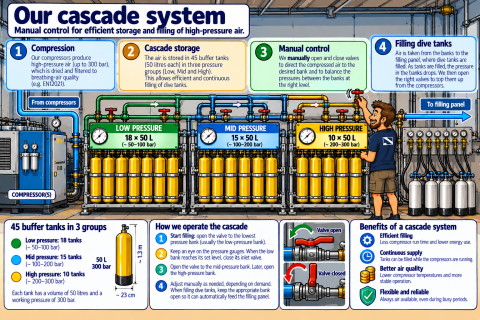
Buffer tanks have another important advantage: they make it possible to use a cascade. Instead of using all the buffer tanks as one large air reserve, they are divided into separate banks. This brings us to a principle that every divemaster who regularly fills cylinders should really understand: having a reserve of air is one thing; using that reserve efficiently is another. That is what a cascade system is for.
Suppose we have an 11-litre scuba cylinder with 50 bar remaining after a dive. We want to fill it back to 200 bar. Behind our filling panel are three buffer banks. These could be three individual buffer tanks, but at larger filling stations they may also consist of groups of several interconnected buffer tanks:
LOW → MID → HIGH
These names do not refer to fixed pressures. We use LOW for the first part of the fill, MID for the next part, and save HIGH for the final part. As air is used and the buffers are refilled, their pressures change, and in a manually operated cascade system the roles of the different banks may change as well.
As soon as we connect a buffer bank to a scuba cylinder, air naturally flows from the higher-pressure side to the lower-pressure side. This continues until the pressures become equal — or until we close the valve and switch to the next bank. Without assistance, a buffer bank can never fill a scuba cylinder to a pressure higher than the pressure remaining in the bank itself.
That is why we start with LOW. As long as the pressure in LOW is higher than the pressure in the scuba cylinder, we can still use that air. A buffer bank at, for example, 120 bar can therefore still be perfectly useful for transferring air into a scuba cylinder at 50 bar. It would be a waste to use our valuable high-pressure reserve for that. This is the essence of cascading: use low pressure for as long as low pressure is sufficient, and save high pressure for the final part of the fill. But how much difference does that actually make? What does a cascade really achieve?
Let us use a somewhat larger filling station as an example. We have a total of twenty 50-litre buffer tanks, all filled to 280 bar. At the same time, sixty scuba cylinders arrive. They are 11-litre cylinders with an average remaining pressure of 50 bar after the dive, and they need to be filled back to 200 bar. Each scuba cylinder therefore needs:
11 × (200 − 50) = 1,650 litres of air
For sixty cylinders, we need a total of:
60 × 1,650 = 99,000 litres of air
At first glance, that seems to be no problem at all. Our twenty buffer tanks have a combined internal volume of 1,000 litres and are filled to 280 bar. So, very roughly, they contain 280,000 litres of free air. More than enough, you might think.
But suppose we connect all twenty buffer tanks together to form one large bank. To fill a scuba cylinder to 200 bar, the pressure in that bank has to remain above 200 bar. Of the 280 bar we started with, we can therefore actually use only about 80 bar:
1,000 × (280 − 200) = 80,000 litres
That is not enough to fill all sixty scuba cylinders. We need 99,000 litres, but can extract only about 80,000 litres from the bank before its pressure drops to around 200 bar. The strange thing is that at that point we are not short of air at all. There are still approximately 200,000 litres of air in the buffer tanks. The problem is that this air is now at around 200 bar. So we still have an enormous amount of air, but no longer enough pressure to finish filling our scuba cylinders to 200 bar.
That is precisely why we divide the same twenty buffer tanks into separate banks. For example:
LOW: 10 × 50 L = 500 litres
MID: 5 × 50 L = 250 litres
HIGH: 5 × 50 L = 250 litres
All three banks start at 280 bar in our example. We now use LOW for the first part of every fill. This bank can eventually fall well below 200 bar. That is not a problem: as long as the pressure in the scuba cylinder is lower, we can continue to use the air from LOW.
When LOW no longer provides enough pressure difference, we switch to MID. Only for the final part of the fill do we use HIGH. We try to keep this bank at high pressure for as long as possible, because it is precisely this high pressure that we need to bring the scuba cylinders all the way up to 200 bar. With this cascade arrangement, we can make much greater use of the same air reserve. In our simplified example, we can fill all sixty scuba cylinders from 50 to 200 bar.
So we started with exactly the same twenty buffer tanks and exactly the same amount of air. The only thing we changed was how we used that reserve. And this demonstrates something important: a cascade system does not give you more air. It allows you to use much more of the air you already have. At a filling station, it is not only the quantity of air that is valuable, but also the pressure at which that air is available. One hundred thousand litres of air at 100 bar can be extremely useful for the first part of a fill, but it cannot fill a cylinder to 200 bar. For that, part of the reserve has to be kept at a higher pressure.
How fast should you fill a scuba cylinder?
A large pressure difference has another consequence. If we connect a nearly empty scuba cylinder to a high-pressure buffer bank and immediately open the valve fully, an enormous amount of air can flow into the cylinder in a very short time. That may seem efficient, but it is not a good idea.
As we saw earlier with the compressor, air heats up when it is compressed. The same thing happens when filling a scuba cylinder. The faster we fill, the less time there is for that heat to escape through the cylinder wall into the surrounding environment. The air inside the cylinder can therefore become quite warm. This also affects the final filling pressure. Gas pressure is related to temperature. A warm cylinder that reads 200 bar immediately after filling may, for example, read only 190 bar after it has cooled. You have not suddenly lost air; the same amount of air simply produces a lower pressure at a lower temperature.
That is why the valves of a buffer system should be opened slowly and gradually. This is especially important when the pressure difference is large. The aim is not to bring the cylinder up to pressure as quickly as possible, but to fill it in a controlled way and keep heat generation within reasonable limits. Manufacturers may specify maximum or recommended filling rates, and these should always be followed.
In the past, filling stations therefore often had large water tanks in which scuba cylinders were placed during filling. The water could absorb some of the heat from the cylinder and help keep its temperature lower during filling. Such water baths are much less common today. A controlled filling rate usually makes them unnecessary, while a water tank also has disadvantages of its own: the cylinder and valve remain constantly wet, and water can more easily get into the filling connection.
The most important principle therefore remains simple: do not fill faster than necessary. Give the cylinder and the air time to release heat to the surrounding environment, and remember that the pressure in a warm cylinder will drop after filling as it cools. As a guideline, a filling rate of around 20–40 bar per minute is often mentioned for scuba cylinders. A cylinder that needs to go from 50 to 200 bar would therefore take approximately 4 to 8 minutes at that rate. Technically, it is often possible to fill the same cylinder in two or three minutes, but this creates more heat and therefore a greater pressure drop when the cylinder cools afterwards.
Filling more slowly does not necessarily mean that a filling station can process fewer cylinders per hour. If you want to fill efficiently, it is better to invest in more filling points than in a higher filling rate. A filling station where, for example, 16 or 20 cylinders can be connected simultaneously can distribute the air slowly across all those cylinders and still process a large number of cylinders per hour. A station with only four or six filling points will be under much greater pressure to get each individual cylinder off the panel as quickly as possible.
When the ambient temperature is very high, as it is at many typical diving destinations, especially in the afternoon, it can also be useful not to take the cylinders straight to 200 bar. Instead, they can first be filled to, for example, 180 bar, allowed to cool, and then topped up afterwards. Efficient filling therefore does not necessarily mean fast filling. Above all, it means filling many cylinders at the same time, in a controlled manner and at a sensible filling rate. Geplakte markdown
Finally, into the cylinder
After all the compression stages, cooling, separation, filtration, checks and buffer tanks, we finally arrive at the last part of the installation: the filling hose. To the person filling the cylinder, this may seem like the simplest part of the entire process. You connect a cylinder, open a few valves and wait until the pressure gauge reads 200 bar. But precisely because we are working with high pressure here, it is important to follow the same fixed procedure every time.
Before connecting a cylinder, first check whether it may actually be filled. Inspect the cylinder, valve and filling connection and make sure there is no visible damage or any other reason not to fill the cylinder. Depending on the filling station, this should also include checking the inspection date and permitted working pressure. A cylinder designed for 200 bar should obviously not simply be filled to 300 bar.
Next, remove the dust cap and connect the filling hose correctly. The connection to the cylinder valve uses the same two systems familiar from scuba regulators: DIN and INT (yoke). Both traditional screw or yoke connections and quick-connect systems are available, the latter making it easier to connect large numbers of cylinders.
Only once everything has been connected correctly should you slowly start the airflow. Especially when there is a large pressure difference, this should be done gradually. Open the air supply slightly at first and allow the pressure to rise in a controlled manner. When several cylinders are being filled at the same time, the air can be distributed across multiple filling points. Open the valves further only as far as the desired filling rate allows.
During filling, monitor not only the pressure but also the temperature of the cylinder. A cylinder may become warm during filling, but if it becomes very hot very quickly, that is a good reason to reduce the filling rate. Also remember that the pressure will drop slightly after filling as the cylinder cools. When filling large numbers of cylinders, it may therefore be practical to first fill them to around 180 bar, allow them to cool, and then slowly top them up to 200 bar.
Once the desired final pressure has been reached, close the air supply and/or cylinder valve. Then depressurise the filling hose using the appropriate bleed valve. Only when the hose is completely depressurised should you disconnect the filling connection. If necessary, check the final pressure once more and then replace the dust cap on the valve.
At many filling stations, the dust cap therefore has a useful second function: cap off means the cylinder still needs to be filled; cap on means the cylinder is filled and ready for use. This makes it immediately clear which cylinders still need to go to the filling panel and which ones are ready to head back to the dive site.
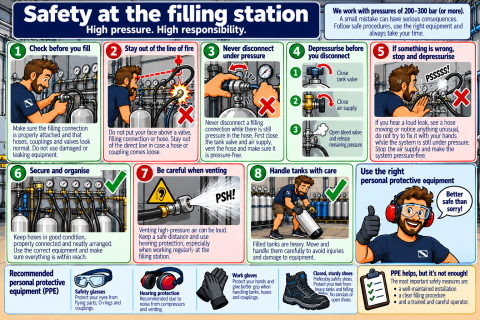
Working safely at the filling panel
A filling system operates at pressures of 200 to 300 bar or more. This means that even a relatively small mistake can have serious consequences. A filling hose that comes loose under pressure, for example, can whip around with considerable force, while high-pressure air escaping through a small opening can be released at extremely high velocity.
Before filling, therefore, always check that the filling connection is securely attached and that hoses, couplings and valves look normal. Do not use a filling hose with visible damage, leakage or a suspicious coupling until it has been inspected. During filling, do not lean over a valve, filling connection or hose with your face directly above it. Stay out of the direct line of couplings and connections as much as possible. If something comes loose or fails, you do not want to be standing directly in front of it.
A connection should also never be disconnected while the filling hose is still under pressure. First close the cylinder valve and the air supply, then depressurise the filling hose using the appropriate bleed valve. Only after checking that the connection is completely depressurised should you disconnect it.
If you suddenly hear a loud leak during filling, see a hose moving, or notice anything else that is not normal, do not try to solve the problem with your hands while the system is still under pressure. First stop the air supply and depressurise the affected part of the system.
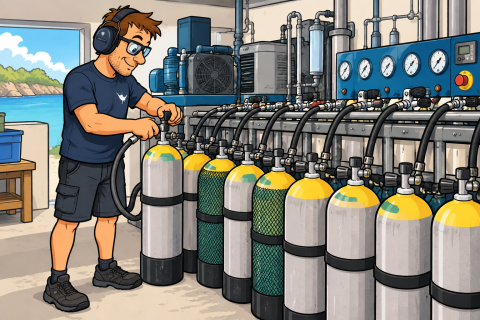
Anyone filling cylinders should also take appropriate steps to protect themselves. Safety glasses protect the eyes if something unexpectedly goes wrong with a connection, O-ring or coupling. A compressor room or filling station can also produce considerable noise. Even depressurising filling hoses can produce a short but sharp burst of sound. Hearing protection is therefore sensible, especially when working at the filling station for extended periods.
Work gloves can also be practical. Not so much because of the high pressure itself, but because during a busy filling day you are constantly handling heavy cylinders, valves, hoses and couplings. This can be hard on your hands. Make sure, however, that the gloves still provide enough grip and sensitivity to operate valves and couplings properly.
Finally, sturdy closed shoes, preferably safety shoes, are certainly not an unnecessary luxury. A filled scuba cylinder is heavy, and a cylinder that falls over or slips out of your hands while being moved can cause serious injury to your feet. Flip-flops and other open footwear therefore really have no place at a filling station.
Personal protective equipment does not, of course, automatically make filling safe. The most important protection remains a well-maintained system, a consistent filling procedure and an operator who knows what they are doing.
Just air?
We began this chapter with a reassuring message for new divers: there is really nothing particularly unusual inside a scuba cylinder. No oxygen and no mysterious breathing gas, but simply the same air we breathe every day. After everything we have discussed by now, the words ‘just air’ may sound a little different.
We now know that this air first has to be drawn in from a suitable location, and that even ordinary ambient air can contain water vapour, dust, exhaust gases and other contaminants. We have seen how a compressor takes that air through several stages from approximately 1 bar to 200 or 300 bar, why so much heat is generated in the process, and why a surprising amount of water has to be removed along the way.
We also know by now that a compressor alone does not produce breathing air. The air has to be cooled, condensate has to be separated, and the remaining water vapour, oil and other contaminants have to be reduced to safe levels. We have encountered molecular sieve, activated carbon and catalysts, and seen that the simple word filtering actually covers several different physical and chemical processes. And we know that ‘clean’ is not simply a matter of judgement. Breathing-air standards specify limits for substances and parameters including oxygen, carbon monoxide, carbon dioxide, moisture and oil. To know whether our own air meets those requirements, we have to measure it — and even our measuring equipment itself needs to be checked regularly.
That clean breathing air then still has to be stored and distributed. Buffer tanks not only provide us with a large reserve of air; a cascade system also allows us to use the available pressure efficiently. Eventually, the air reaches the cylinder through the filling panel and filling hose, where filling rate, temperature, final pressure and safety once again play an important role.
Anyone who has read all of this is therefore no longer really a complete beginner. That does not mean you have to be a compressor technician or that you need to be able to repair every component of a filling station yourself. But by now, you understand what is happening, why it is happening and where things can go wrong. For a divemaster or instructor, that may be the most important thing of all. Because every time you open a valve and breathe from your regulator, you are trusting that someone before you carried out all of those steps correctly. And in the end, there really is just air in your cylinder. But quite a lot has to happen to get it there.
