Measuring and calculating in diving
Metric and imperial calculation languages compared
Diving is not just about feeling and experiencing — it’s also about measuring and calculating. How deep do you go? How much air do you use? How long can you stay? And how fast are you allowed to ascend? Underwater, surprisingly much revolves around numbers. Fortunately, the math is usually simple — but what doesn’t make it any easier — or safer — is that two sets of measurements and two systems are used.
I grew up in Europe and learned to think in the metric system. When I later learned to dive, that felt natural: depth in meters, pressure in bar, tank volume in liters, consumption in liters per minute. But at the same time, I saw feet, psi, ATA, and cubic feet popping up in the course materials — things that seemed quite exotic to me at the time. I began to realize that divers worldwide actually calculate in two different languages.
And that’s exactly where the problem begins, but also the challenge. For American divers, feet, psi, and cubic feet are not strange or cumbersome units, but the familiar language in which they learn to dive. For dive professionals outside the US, it is therefore useful to learn to understand that system as well. At the same time, the question arises whether a single worldwide system for diving would ultimately be safer and more logical.
In what follows, we’ll first look at how both systems are structured, then how they work in the practice of diving, and finally why standardization might be desirable.
The Alchemy of the Imperial System
Let’s first briefly look at where these alternative units come from — a concise introduction for non-Americans to feet and inches, ounces and pounds, gallons and other imperial units.
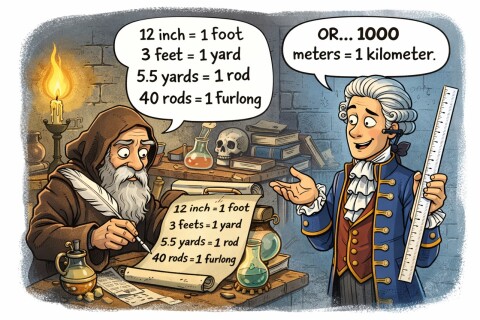
The foot is one of the oldest units of length in existence and fits in the list of the ell, thumb, palm, (double) pace, span, and fathom: units based on parts of the human body. The foot as a unit already existed with the Egyptians and Romans, but varied as much as human feet themselves. Although there were many historical variants, by the 19th and 20th centuries the British foot and the American foot were practically identical in use. Industry, trade, and science had essentially "smoothed this out" and defined it as a large man’s foot. One twelfth of that is an inch (in Dutch: duim). From there, the system grows further:
12 inches = 1 foot
3 feet = 1 yard
5.5 yards = 1 rod
40 rods = 1 furlong
8 furlongs = 1 mile
Compare that to the metric system:
10 mm = 1 cm
100 cm = 1 m
1000 m = 1 km
Where the metric system works neatly in steps of ten, the imperial system has grown historically and is built from less uniform ratios. You see the same with mass:
1 ounce (oz) ≈ 28.35 grams
16 ounces = 1 pound (lb) ≈ 453.6 grams
14 pounds = 1 stone ≈ 6.35 kg
2000 pounds = 1 short ton (US) ≈ 907 kg
2240 pounds = 1 long ton (UK) ≈ 1016 kg
For weight, there are even several systems alongside each other. The avoirdupois system is used in daily life, while the troy system is used for precious metals — each with their own definitions of ounce and pound. There was also a separate system for apothecaries, again with different units. Even after standardization in 1959, subtle differences remained between American and British units.
With volume, it quickly becomes complex as well:
1 fluid ounce (fl oz)
16 (US) or 20 (UK) fl oz = 1 pint
2 pints = 1 quart
4 quarts = 1 gallon
On top of that, the same name sometimes refers to different quantities: an ounce can be a unit of mass or of volume (fluid ounce). That these roughly correspond for water is a historical coincidence — and that’s exactly what makes the system less transparent. Nowadays, all these units are defined exactly in relation to the metric system. An inch, for example, is exactly 2.54 cm, a pound exactly 0.45 kg (with many more digits after the decimal), and a US gallon — slightly smaller than a UK gallon — is 3.78 liters (also with many more digits after the decimal).
For those who grew up with it, this system works fine. But for outsiders, it quickly feels like a form of alchemy: a historically grown whole with less direct internal logic. At the same time, for American divers, feet, psi, and cubic feet are not strange or cumbersome units, but the familiar language in which they learned to think about diving. For dive professionals outside the United States, it is therefore not enough to dismiss this system as an outdated medieval system — it is at least as important to understand and be able to translate it. Anyone working with international divers must therefore not only master a language like English, but also a second way of measuring and calculating. Even if you speak English fluently, if you only think in meters and bar, you sometimes miss that connection. A good diving instructor is therefore able to switch smoothly between both systems.
In what follows, we’ll look at the main units in which these differences become visible in the practice of diving.
Temperature: Celsius vs. Fahrenheit
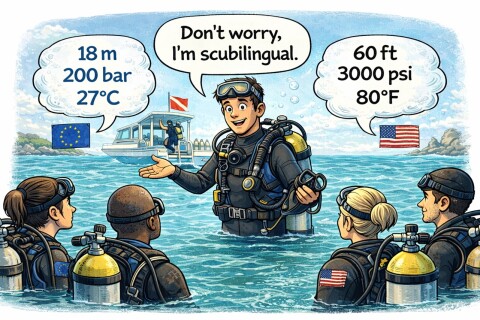
Let's start with the easiest difference: the way temperature is measured. While most of the world uses degrees Celsius, Americans still use degrees Fahrenheit today.
During the eighteenth century, several temperature scales were developed. Daniel Gabriel Fahrenheit, originally from Prussia, created his scale in Amsterdam using reference points such as a saltwater brine mixture and human body temperature. Around the same time, Anders Celsius, working in Uppsala, Sweden, developed a scale based on the freezing and boiling points of water, ranging from 0 to 100 degrees. Other scales, such as those developed by Réaumur and Rømer, also existed during this period but gradually disappeared. Eventually, Celsius and Fahrenheit became the two dominant temperature scales for everyday use, while William Thomson (Lord Kelvin) later introduced the Kelvin scale for scientific purposes, based on absolute zero. From this collection of competing systems, only a handful of standards remain in use today.
Both the Celsius and Fahrenheit scales are ultimately based on the freezing and boiling points of water. Celsius uses a logical decimal scale from 0 to 100, whereas Fahrenheit uses the same two reference points but divides them into 180 smaller increments, from 32 to 212 degrees. Both scales are linear—the main differences are the chosen reference points and the size of the increments.
To convert Celsius to Fahrenheit, multiply by 1.8 and add 32:
°F = (°C × 1.8) + 32
To convert Fahrenheit to Celsius, subtract 32 and divide by 1.8:
°C = (°F − 32) ÷ 1.8
(The factor 1.8 accounts for the difference in scale, while 32 represents the difference in the zero point.)
If you just need a quick mental estimate, simply double the Celsius temperature and add 30. To convert the other way, subtract 30 and divide by two. It isn't perfectly accurate, but it is close enough for everyday diving.
Applying this to Curaçao, the sea temperature typically ranges from 25°C to 30°C (77°F to 86°F), with an average of around 27°C (80°F) throughout the year.
Depth: Metres vs. Feet
Over the past two centuries, almost the entire world has adopted the metric system, measuring distances in millimetres, centimetres, metres, and kilometres. Americans, however, still express short distances in feet and inches, and longer distances in miles. For example, a person's height is typically given as a combination of feet and inches. Someone who is 1.80 metres tall would be described as 5 feet 11 inches, or simply 5'11".
In diving, we don't need inches any more than we need centimetres. It is sufficient to express depth in either feet or metres. Here are some of the most common depth milestones in recreational diving:
- Safety stop: 5 metres (15 feet)
- Try Scuba / Introduction dives: maximum 12 metres (40 feet)
- Open Water Divers: certified to a maximum depth of 18 metres (60 feet)
- Advanced Open Water: maximum training depth of 30 metres (100 feet)
- Recreational diving: maximum depth of approximately 40 metres (130 feet)
You may notice that these numbers are slightly "neater" in the imperial system. That reflects the fact that training agencies such as SSI and PADI originated in the United States rather than Europe. European organisations such as CMAS, for example, traditionally use metric depth limits of around 20, 30, and 40 metres.
Historically, the length of a foot varied considerably, ranging from about 25 to 33 centimetres. It was not until the International Yard and Pound Agreement of 1959 that the foot was standardised at exactly 30.48 centimetres.
To convert feet to metres, multiply by 0.3048 (or divide by 3.2808).
To convert metres to feet, multiply by 3.2808.
For quick mental calculations, simply divide or multiply by 3. It isn't exact, but it is usually close enough for practical diving purposes.
While the foot is as old as civilisation itself, the metre is a product of the Enlightenment. During the French Revolution, at the end of the eighteenth century, French astronomers Jean-Baptiste Delambre and Pierre Méchain defined the metre as one ten-millionth of the distance from the Equator to the North Pole. That distance is approximately 10,000 kilometres, although the true value differs slightly because the Earth is not a perfect sphere.
Originally, the metre was represented by a physical standard: a platinum bar kept in a secure vault near Paris. That bar was the metre, and every other measuring instrument was calibrated against it. During the second half of the twentieth century, this physical standard was replaced by a definition based on the speed of light. The original metre bar still exists and is carefully preserved—not as a practical standard anymore, but as a reminder of humanity's first attempt to define the world using a single universal unit of measurement.
Pressure: Bar vs. PSI and ATA
Just as with depth, there are two common ways of expressing pressure in diving: bar and psi (pounds per square inch). Throughout Europe and most of the world, scuba cylinders and pressure gauges are calibrated in bar, whereas in the United States they are calibrated in psi.
Both units describe exactly the same thing: pressure as force applied over a given area. The difference lies in their origin. Psi is part of the imperial system and expresses how many pounds of force are exerted on one square inch of surface area.
The metric unit bar, on the other hand, is derived from the pascal and is close to average atmospheric pressure at sea level (1 bar ≈ 100,000 pascals). A pascal is defined as one newton per square metre, and a newton is the force required to accelerate a mass of one kilogram by one metre per second squared. Under Earth's gravity (approximately 9.81 m/s²), one newton corresponds roughly to the weight of 100 grams. A pressure of one bar therefore equals 100,000 newtons per square metre, which is approximately the same as one kilogram of force per square centimetre.
One bar is equivalent to approximately 14.7 psi. In practice, 200 bar is roughly the same as 3,000 psi—a number that feels just as familiar to American divers as 200 bar does to European divers. More precisely, 3,000 psi equals about 207 bar.
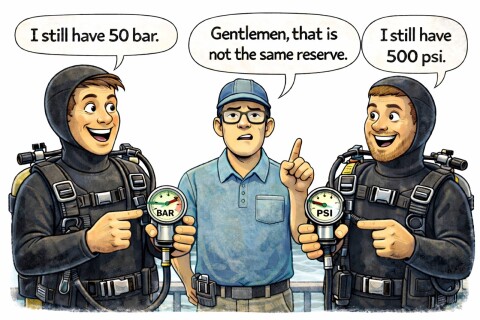
Interestingly, American divers have traditionally been taught to begin their ascent with 500 psi remaining, while European divers typically use 50 bar. These values are not actually equivalent. Fifty bar represents about one quarter of a full cylinder, whereas 500 psi is only about one sixth. For that reason, many American instructors now recommend 750 psi, which is much closer to the European 50-bar reserve.
When it comes to ambient pressure, however, American divers use yet another unit: ATA (atmospheres absolute). This is because working directly with psi underwater is not very convenient. One atmosphere equals approximately 14.7 psi, and pressure increases by about 4.45 psi for every 10 feet (3.3 metres) of seawater. Those are not particularly easy numbers to calculate mentally.
American dive manuals simplify the relationship between depth and pressure by first converting the familiar metric reference depths into feet. Thus, 10, 20, 30, and 40 metres become 32.8, 65.6, 98.4, and 131.2 feet, which are then rounded to the much simpler values of 33, 66, 99, and 130 feet. Instead of expressing ambient pressure in psi, it is usually expressed in ATA. Since 1 ATA ≈ 1.013 bar, the relationship between depth and pressure becomes almost identical to the metric system.
This creates a straightforward system in which ambient pressure increases by 1 bar or 1 ATA every 10 metres (33 feet). It allows American divers to perform reasonably simple mental calculations. Even so, it has to be said that the metric system remains considerably more intuitive and easier to work with.
Scuba Cylinder Volume: Litres vs. Cubic Feet
This is where the imperial system becomes truly confusing. Unlike almost every other container, scuba cylinders in North America are not described by their internal volume—not in litres, and not even in gallons—but by an entirely different measurement.
In Europe, things are straightforward. Cylinders are named after their actual internal (water) volume. A 10-, 12-, or 15-litre cylinder really does have an internal volume of 10, 12, or 15 litres. The imperial equivalent of the litre is the U.S. gallon (1 gallon = 3.78 litres), so these cylinder sizes correspond roughly to 2.5, 3, and 4 gallons.
The table below shows how these European cylinder sizes translate into U.S. gallons and, for comparison, into cubic feet of free gas when filled to 232 bar (3,365 psi).
| Cylinder size |
Working pressure |
Volume in liters |
Volume in U.S. gallon |
Volume in cuft |
|
3 L |
232 bar / 3365 psi |
3 L |
0,79 gal |
25 cuft |
|
5 L |
232 bar / 3365 psi |
5 L |
1,32 gal |
41 cuft |
|
7 L |
232 bar / 3365 psi |
7 L |
1,85 gal |
57,5 cuft |
|
10 L |
232 bar / 3365 psi |
10 L |
2,64 gal |
82 cuft |
|
12 L |
232 bar / 3365 psi |
12 L |
3,17 gal |
98,3 cuft |
|
15 L |
232 bar / 3365 psi |
15 L |
3,96 gal |
123 cuft |
In North America, however, scuba cylinders are identified by their cubic feet (cuft) rating. This is not a measure of the cylinder's physical size. Instead, it represents the amount of air the cylinder contains when filled to its nominal working pressure, expressed as the equivalent volume of air at normal atmospheric pressure.
For a standard AL80, this means:
- Working pressure: 3,000 psi (≈ 207 bar)
- Gas capacity: 80 cubic feet of free air
One cubic foot is roughly the size of a medium moving box. Eighty cubic feet is therefore quite a large volume—approximately 2.3 cubic metres, comparable to the volume of a small bathroom or walk-in closet (about 1 × 1 × 2.2 metres). In other words, if you released all the air from a full AL80 cylinder, it would fill a room of roughly that size.
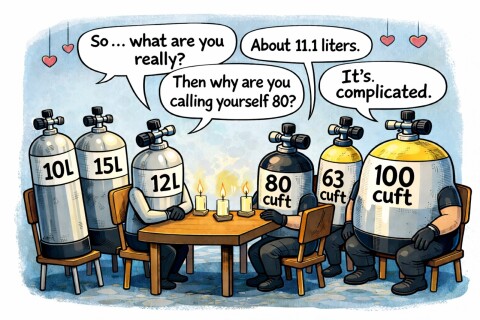
The cylinder itself, however, is much smaller. Its actual internal volume is only about 0.375 cubic feet (11.1 litres).
The table below compares the common North American cylinder sizes with their actual internal volumes.
|
Cylinder size |
Working pressure |
Volume in liters |
Volume in U.S. gallons |
Water volume in cuft |
|
19 cuft |
3000 psi / 207 bar |
2,7 L |
0,71 gal |
0,10 cuft |
|
40 cuft |
3000 psi / 207 bar |
5,7 L |
1,51 gal |
0,20 cuft |
|
50 cuft |
3000 psi / 207 bar |
7,0 L |
1,85 gal |
0,25 cuft |
|
63 cuft |
3000 psi / 207 bar |
8,9 L |
2,35 gal |
0,31 cuft |
|
80 (77,4) cuft |
3000 psi / 207 bar |
11,1 L |
2,93 gal |
0,38 cuft |
|
100 cuft |
3300 psi / 228 bar |
13,9 L |
3,67 gal |
0,49 cuft |
It is worth noting that the designation "80 cuft" is not entirely accurate. A standard AL80 actually contains about 77.4 cubic feet of free air when filled to its rated pressure. The name is therefore rounded for convenience. Other cylinders, such as the 63 cuft and 100 cuft, are closer to their actual gas capacities, but they are still nominal designations rather than exact measurements.
European cylinders, by contrast, are simply named according to their actual internal volume, with only minor manufacturing tolerances.
Confusion in Practice
In places such as Curaçao, where American aluminium cylinders are commonly used, they are often incorrectly referred to by their "European" sizes.
For example:
- An 80 cuft cylinder is often called a 12-litre cylinder.
- A 63 cuft cylinder is often called a 10-litre cylinder.
- A 100 cuft cylinder is often called a 15-litre cylinder.
In reality, their internal volumes are approximately 11.1 litres, 8.9 litres, and 13.9 litres, respectively. Treating them as 10-, 12-, and 15-litre cylinders therefore overestimates their size by roughly 8–12%.
A more accurate way to think of them is as 9-, 11-, and 14-litre cylinders.
The important point is that the difference is not merely one of units—it is a difference in what is actually being measured.
In Europe, cylinders are named according to their actual internal volume. Calculating the amount of gas they contain is straightforward:
12 litres × 200 bar = 2,400 litres of free gas
In North America, cylinders are named according to the amount of free air they contain at their rated working pressure, converted back to atmospheric pressure. The cylinder designation (for example, 80 cuft) is therefore already the end result of the calculation, making it less intuitive and more difficult to compare cylinders of different sizes.
For this reason, the metric system is much more direct and intuitive. A 12-litre cylinder is simply a 12-litre cylinder.
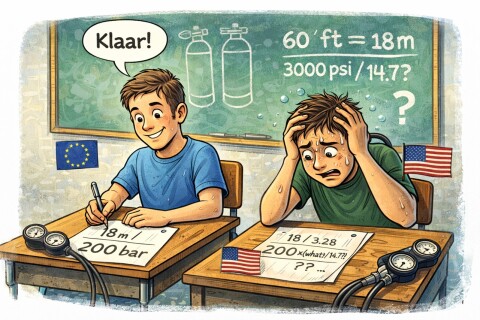
Metric vs. Imperial System: Three Calculation Examples
First Example: Calculating Personal Air Consumption
A good example of the difference between the two systems is calculating personal air consumption during a dive — this time with exactly the same tank.
Take a dive of 45 minutes with an average depth of 14 meters. The diver uses an AL80, which amounts to a water capacity of about 11.1 liters. He starts with 200 bar and ends with 50 bar, so the consumption is 150 bar. In the metric system, you start by determining the ambient pressure. Since every 10 meters corresponds to about 1 bar of extra pressure, the pressure at 14 meters is 1 + 1.4 = 2.4 bar.
The calculation is then simple: 11.1 liters × 150 bar yields 1665 liters of gas. Divided by 45 minutes, that comes to 37 liters per minute at depth. By dividing this by the ambient pressure of 2.4 bar, you get the surface air consumption. The result is a personal air consumption (SAC) of about 15.4 liters per minute.
If we perform exactly the same dive in the imperial system, we use the same physical tank, but now expressed as an AL80 with a nominal capacity of 77.4 cubic feet at 3000 psi. The diver starts with about 2900 psi and ends with about 725 psi, which corresponds to the same pressure difference of 150 bar. The depth of 14 meters corresponds to about 46 feet. To determine the ambient pressure, you must divide this value by 33 and add 1, which again comes to about 2.4 ATA.
To calculate gas consumption, you must first determine the consumed portion of the tank: 2175 divided by 3000, multiplied by 77.4 cubic feet. This amounts to about 56 cubic feet of gas. Divided by 45 minutes, this gives a consumption of about 1.25 cubic feet per minute at depth. Converted to the surface, at a pressure of 2.4 ATA, this results in a SAC of about 0.52 cubic feet per minute.
Both calculations describe exactly the same dive with exactly the same tank. The difference lies solely in the method of calculation. In the metric system, you work directly with volume and pressure — the physical properties of the tank. In the imperial system, you must first convert from a nominal value to an actual gas volume before you can perform the same calculation.
Second Example: Calculating MOD
A second example where the difference between the two systems becomes clearly visible is calculating the maximum operating depth (MOD) of Nitrox.
Suppose a diver is diving with Nitrox 32 and wants to maintain a maximum partial oxygen pressure of 1.4 bar. The first step is the same in both systems: we determine at what ambient pressure this partial oxygen pressure is reached. We do this by dividing the allowed partial pressure by the oxygen fraction. For EAN32, this means 1.4 divided by 0.32, resulting in an ambient pressure of 4.375 bar.
So far, there is no difference between the metric and imperial systems. The difference only arises in the second step: converting this pressure back to a depth.
In the metric system, this step is simple. At the surface, there is already a pressure of 1 bar, so underwater there is 3.375 bar left. Since each extra bar in seawater corresponds to about 10 meters of depth, it follows that the maximum depth is 3.375 × 10 = 33.8 meters.
In the imperial system, the first step is essentially the same: you also arrive at an ambient pressure of 4.375. Then this pressure must be converted back to depth in feet. Here, about 33 feet per atmosphere is used. After subtracting the surface, 3.375 remains, which is multiplied by 33, leading to a maximum depth of about 111 feet.
Both calculations describe exactly the same situation and lead to the same result, only expressed in different units. Again, the difference lies in the method of calculation. In the metric system, the relationship between pressure and depth is direct and simple: each extra bar represents about 10 meters. In the imperial system, the same step must be made with a less intuitive factor of 33, making the calculation less straightforward.
Third Example: Calculating Remaining Bottom Time
A third example where the difference between the two systems becomes clear is the question every diver asks during a dive: how much longer can I stay?
Suppose a dive at 20 meters depth. A diver has 120 bar left in his tank and wants to keep a reserve of 50 bar. So there are 70 bar available. His personal air consumption at the surface is 17 liters per minute.
In the metric system, the calculation is straightforward. First, you determine how much gas is still available. With a tank with a water capacity of 11.1 liters, 70 bar corresponds to 11.1 × 70 = 777 liters of gas. Then you calculate the consumption at depth. At 20 meters, the ambient pressure is about 3 bar, so the consumption is 17 × 3 = 51 liters per minute. By dividing the available gas by this consumption, there is about 777 / 51 ≈ 15 minutes of bottom time left.
If we perform exactly the same situation in the imperial system, we again use the same physical tank, but now expressed as an AL80 with a nominal capacity of 77.4 cubic feet at 3000 psi. The diver has 1800 psi left and keeps a reserve of 700 psi, which amounts to 1100 psi of usable gas. To determine how much air that is, you must first calculate the corresponding volume: 1100 divided by 3000, multiplied by 77.4 cubic feet. This amounts to about 28.4 cubic feet of gas.
At 66 feet depth, the ambient pressure is about 3, so the consumption is 0.6 × 3 = 1.8 cubic feet per minute. By dividing the available gas by this consumption, there is about 28.4 / 1.8 ≈ 16 minutes of bottom time left.
Both calculations describe exactly the same situation and lead to almost the same result. Again, the difference lies in the method of calculation. In the metric system, you work directly with volume and pressure, making the steps logical and clear. In the imperial system, you must first convert from pressure to gas volume before you can perform the same calculation.
Ascent Rate: A Rare Exception
There is one point where the imperial system can actually feel surprisingly intuitive, and that is the ascent rate.
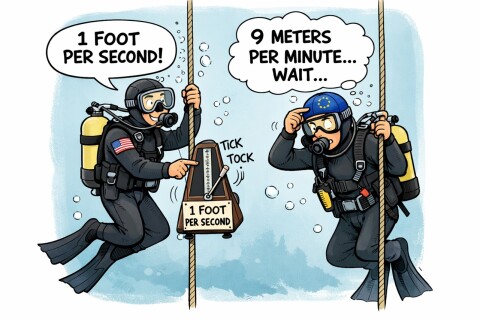
When I used to teach according to PADI, I taught my students that the maximum ascent rate is 18 meters per minute. In the metric system, that is a fairly abstract number — because how fast is that really?
In the imperial system, it suddenly fits nicely: 18 meters per minute corresponds to 60 feet per minute — or exactly 1 foot per second. And that is immediately a pace you can feel and follow. One foot per second is something you can fairly easily estimate in real time underwater.
Nowadays, as an SSI professional, I use a maximum ascent rate of 9 meters per minute. That comes down to about 30 feet per minute — so half a foot per second, or one foot every two seconds. That is still easy to visualize, but just a bit less elegant than that one foot per second.
This is a good example of how the imperial system can feel practical in some cases. The exception proves the rule: in most other situations in diving, the metric system turns out to be clearer and more direct.
Plea for the Metric System
For the practice of diving, the metric system simply aligns better with the physics underwater. In the metric system, the relationships between pressure, volume, and gas consumption are much simpler. Anyone calculating in meters, bar, and liters can immediately see how everything is connected. The same calculations in feet, psi, and cubic feet become noticeably more cumbersome and less transparent. That’s why many serious divers eventually switch to the metric system—if only because it makes dive planning clearer and less prone to errors.
Yet American divers remain remarkably attached to the imperial system. So much so that some training organizations continue to use imperial units in all their teaching materials, even in translations—as if feet and psi are universal units.
The industry also proves to be conservative, sticking to existing sizes and habits. That is understandable in itself: switching to other units involves costs. Think of adjusting production processes, redesigning equipment, changing documentation, and retraining staff. As long as the existing system works “well enough,” the incentive to change is often limited. What is happening more and more, however, is that American manufacturers list the metric measurement alongside the imperial one. An “80 cubic feet” tank has become so ingrained that it is more of a product name than a pure measurement. The real change seems to be happening in the way divers calculate with such a tank. More and more often, the same cylinder—regardless of its imperial name—is approached in liters and bar. The standard remains, but the calculation language shifts.
You see something similar with wetsuits. In American diving jargon, you often hear about a “3 mil” or “7 mil” wetsuit, while in practice this refers to the thickness of the neoprene in millimeters. Strictly speaking, however, a mil is not a millimeter, but a thousandth of an inch, or 0.0254 mm. Although the mil is still used as a thickness measurement in technical contexts, the word in everyday language around wetsuits seems to be slowly shifting toward millimeter. This is a small but telling sign that in America, people are very slowly—at the speed of tectonic plates—moving toward the metric system.
Finally, everyday language also plays a role. It often proves less willing to change than science and technology. Where those domains have long since switched to a clear and universal system, in daily speech we continue to cling to old units. Our language is full of expressions and imagery that come from a world that has long since disappeared. Old units and measurements live on as part of culture and habit; they may be less practical, but they are familiar. And there’s nothing wrong with that. Tradition and language add color to how we describe the world.
Yet practice shows that as soon as accuracy, international cooperation, and safety play a greater role, the metric system almost automatically prevails. Especially in that context—in which diving also belongs—a clear and directly calculable system simply proves to be the most suitable.
Most countries that used the (British) imperial system have now largely switched to the metric system. Great Britain—the cradle of the imperial system—is a good example. Distances and depths in science and technology are standardly expressed in meters and kilometers, temperature in degrees Celsius, weight in kilograms, volume (e.g., water, fuel) in liters. Yet there are still some notable exceptions where imperial units persist: road signs: distances and speeds in miles and miles per hour, body height and weight: often still in feet/inches and stones/pounds, beer and milk: often still in pints. The result is a hybrid system: officially metric, but with a number of persistent imperial traditions.
You see the same pattern in other former British territories. In Canada, the metric system is the official standard: distances in kilometers, temperature in degrees Celsius, weight in kilograms. But in daily life, imperial units still regularly appear: body height and weight (feet, pounds), home area (square feet), and sometimes volume (gallons). In Australia, the switch to metric has gone even further: almost everything is expressed in meters, liters, and kilograms, speeds in km/h, temperature in Celsius. Imperial units are hardly ever used there anymore, except occasionally in informal contexts (e.g., body height among older generations or historical references).
The United States is an exception. Although the metric system has been officially permitted there for decades and is even preferred in science and industry, it has never been fully adopted in daily life. Since the Metric Conversion Act of 1975, the metric system in the US has been the “preferred system of weights and measures” for trade and industry. In practice, this means that many sectors in the United States do work metrically. In science and research, meters, kilograms, and degrees Celsius are used, and in medicine and pharmacy, milliliters and milligrams are the standard. In industry and technology, metric specifications are also often used, although this is not always applied consistently. Yet in daily life, the imperial system remains dominant. Distances are expressed in miles, speeds in miles per hour, temperatures in Fahrenheit, and weights in pounds. And the price of fuel is not shown in liters but in gallons.
Nevertheless, the metric system is gradually making further inroads in various areas in the United States. Products are often labeled with dual indications, for example in both gallons and liters, and in some fields, such as sports (for example, athletics), distances are standardly measured in meters. In addition, military and scientific applications work almost entirely with the metric system. In education, American youth also systematically encounter metric units, because the metric system is the international standard in STEM subjects. But unlike in countries such as the United Kingdom, Canada, and Australia, there has never been a broad societal transition in the US. Attempts in the 1970s and 1980s to actively introduce the metric system largely failed due to a lack of support and political priority. A large and influential country like the US can afford to stick to its own standards longer, simply because the rest of the world adapts to America more often than the other way around. Yet the first signs of a shift toward a global standard, however slow, are indeed visible.
Not a theoretical but a practical problem
All this raises the question of how desirable it is for different unit systems to continue to coexist within the diving sport. In an activity where safety, communication, and clarity play such a major role, standardization seems obvious. A diver who switches between regions or training organizations must constantly adapt to different units: meters or feet, bar or psi, liters or cubic feet. This increases the chance of misunderstandings, calculation errors, and incorrect assessments—especially in situations where quick and correct action is essential. A globally uniform system would significantly reduce this complexity.
The metric system is the obvious choice: it directly aligns with the underlying physics, makes calculations transparent, and is already used in most of the world. Although full standardization takes time in practice and depends on tradition, industry, and training, it seems desirable for the sake of safety and clarity within diving that the sector gradually moves toward a single uniform system. Training organizations could take the lead by gradually phasing out the use of imperial units and making the metric system central in their teaching materials. Manufacturers of diving equipment can also contribute by making metric measurements the norm in their specifications and product design.
There are plenty of examples of divers confusing feet and meters, pounds and kilograms, or psi and bar, with potentially dangerous consequences.
It probably happens at every dive school that an American who has just assembled a rental set complains that the tank is only filled to 2000 psi, while the gauge actually reads 200 bar. The next tank also shows only "2000 psi." Then the divemaster who hands over the tank suddenly realizes that the customer is confusing bar and psi, and kindly points out the mistake. The culturally insensitive customer receives a small and friendly lesson about different units and double standards in diving, and becomes just a bit more aware of the world.
Another example is that of two European divers who both answer "eight" when asked how much weight they need for their first dive at a Caribbean destination. The divemaster then gives both divers two blocks of 4 pounds. They enter the water but find it difficult to descend because they actually meant 8 kilograms. So they swim back to shore and return for a few extra blocks of weight. More serious, of course, is a mistake in the opposite direction: when a dive school sends people out with more than twice as much weight as they actually need. That could lead to a dangerous situation. Dive schools know that double units are used and good staff will often ask further questions to clarify what someone means.
But the consequences can be even more serious. On Boxing Day 2019, two American divers who had recently been trained in their own country rented a dive set at a dive school in Curaçao. They went out on their own. The equipment they received was, as is usual on the island, metric: the depth gauges showed meters instead of feet. During their dive, they followed their instruments as they were used to—until their gauge showed the number 60. Only, they were not at 60 feet (about 18 meters), but at 60 meters (almost 200 feet). This meant they not only far exceeded the limits of their certification, but also those of recreational diving. At this depth, they were simultaneously exposed to multiple risks: a greatly increased chance of gas narcosis, a partial oxygen pressure well above the safe limit of 1.4 bar, an air consumption more than twice as high as at 18 meters, and a very rapid absorption of nitrogen in the body. The rapid air consumption probably led them to abort the dive early and make a rapid ascent. For a controlled ascent with possible decompression stops, they had neither the necessary air reserves nor the proper training.
At the surface, one of the divers showed severe symptoms of type II decompression sickness: loss of vision, dizziness, and signs of paralysis. Thanks to the quick and adequate intervention of a younger version of myself, help could be provided immediately. Without that help, this incident would very likely have ended fatally. This problem could have been prevented if these young men had been more aware of the fact that they had learned to dive with units and measurements that are not commonly used in the rest of the world.
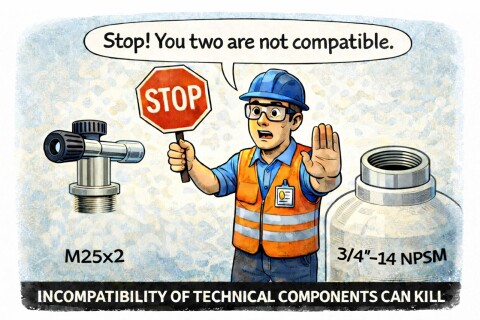
Anyone who thinks that different standards only lead to some calculation confusion, or can only get inexperienced divers into trouble, underestimates the problem. Sometimes the consequences are literally fatal. In October 2022, a diving instructor died in a swimming pool in Amstelveen after a diving cylinder with older British BSPP ¾" internal thread was fitted with a valve with external thread M25x2. At first glance, this may have seemed to fit, but technically the two parts were not compatible. When the cylinder was pressurized, the valve shot off, with fatal consequences. In Australia, in 2016, a service technician was critically injured by a similar mismatch. There are also known incidents in the commercial diving sector where incompatible thread types led to valves shooting off and multiple injuries.
The problem is therefore not purely historical. Even today, different standards exist side by side for the threads used to mount valves on cylinders. The American standard (3/4"-14 NPSM) and the European standard (M25x2) look very similar at first glance, but are technically not compatible. That is precisely what makes them dangerous: a metric M25x2 valve can be forced into an American 3/4"-14 NPSM cylinder with force, with potentially fatal consequences if the connection fails under pressure. These kinds of examples clearly show that different standards are not only cumbersome, but can also become life-threatening in practice when people think that 'almost fitting' is good enough.
Perhaps that is ultimately the crux of the matter: in a sport where safety is central, it helps to work with systems that are as unambiguous as possible. Whether it concerns units we use for calculations or technical standards for fitting equipment together, ambiguity increases the risk of errors. One common standard can contribute to a safer diving world. As long as it does not yet exist, the responsibility lies with the diver and dive professional: not only to be able to calculate in one system, but also to understand the other—and to realize that 'almost the same' can sometimes be dangerously different.