


Working multilingually in diving
A practical toolkit for divemasters and instructors
The Daily Multilingual Practice
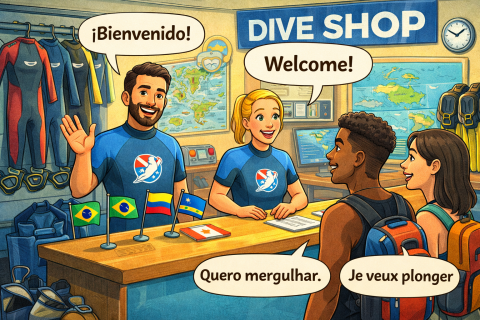
The diving world is an international world — and therefore also a multilingual world. In a place like Porto Mari in Curaçao, we come into contact with five or six languages every day: Dutch, English, Spanish, Portuguese, French, and German. In an ideal world, everyone on the team would master all these languages perfectly and there would never be communication problems. But we don't live in an ideal world. In practice, the language skills of individual team members are almost always more limited than the mix of languages you encounter on an average day.
Everyone on our team is at least bilingual: usually the mother tongue (often Dutch) and English. In practice, we constantly switch between those two languages, and often there is someone who speaks a third language to help guests further. Many of our guests do speak English, but greatly appreciate it when they notice they can also be helped in their own language. This leads to more trust, better communication, and a more pleasant experience. This is especially true for our German and French-Canadian guests.
The biggest challenge is usually with Spanish and Portuguese. Many South American guests mainly speak their own language and explicitly ask if someone speaks Spanish — and are visibly relieved if that's the case. With Brazilian guests, sometimes a conversation arises in "portunhol": a practical mix of Spanish and Portuguese in which both parties try to meet each other halfway. Multilingualism is therefore not an exception, but daily practice.
This page is written for dive professionals who want to expand their language skills. The main message is simple: it is easier than you think to start using an extra language in your work. You don't have to master that language perfectly to be able to work functionally in it.
Lowering the Barrier
We often meet them: dive pros who do speak a third or fourth language, but still hesitate to use it professionally. "Yes, I speak a little Spanish... but not dive-Spanish." Or: "My German is okay, but not good enough to guide or teach in it."
That doubt is understandable — but usually unnecessary. Because in practice, adding an extra language to your work as a dive professional turns out to be much less difficult than you think. You really don't have to master that language perfectly. You don't need to be able to have full conversations about every topic. What you need is something much more limited — and therefore achievable: a set of fixed phrases, recognizable terms, and clear instructions that you use over and over again.
And that is exactly what makes diving so suitable for multilingualism. You are basically doing the same routine every time. Every briefing follows more or less the same structure. The same safety rules come back. You ask the same questions before every dive. And underwater, you already communicate with fixed signals and short confirmations. That means that even in a language you don't yet master perfectly, you can become surprisingly functional very quickly.
The first few times it may be a bit awkward. You search for words, you hesitate, you make mistakes. But that's not a problem — it's part of the process. After just a few dives, you'll notice that the same sentences come back automatically, that you have to think less, and that you become more and more fluent. You'll find that divers greatly appreciate that effort, and are happy to help you where needed. So the barrier is lower than you think. Just go for it.
This page helps you with that. Here you will find practical tools, example sentences, and multilingual lists that you can use as a starting point — not to learn a language perfectly, but just to get started with it in your daily practice as a dive professional. You can already do this in two or three languages. Adding a third or fourth language is therefore less difficult than you think.
Moreover, these languages are quite similar, especially when it comes to diving terminology. If you already speak Dutch and English, you will notice that many German terms are immediately recognizable. And the same goes the other way around. If you speak a bit of holiday Spanish, then learning Spanish diving terminology is much easier than learning Spanish in a field you are not involved with daily. And for those who already speak French reasonably well (or have spoken it before), the step to Spanish — another language in the Romance language family — is not as big as you might think. And the same goes for the step to Portuguese. You will notice that all these languages are surprisingly similar, especially in terms of diving terminology.
Multilingualism as a Superpower
Multilingualism is not a luxury in the diving world, but a real added value. Not only for yourself as a professional, but especially for the experience of your guests.
When you can address someone in their own language — even if only partially — something changes immediately. People feel more at ease, better understand what is expected of them, and are more likely to ask questions. This makes a dive not only more pleasant, but also safer. You see this very clearly with beginners or less experienced divers. A briefing in English is usually understood, but in their own language it comes across just a bit better. Instructions are clearer, nuances are less likely to be lost, and trust grows. And trust may well be the most important ingredient for a relaxed and safe dive.
For you as a dive professional, it also means something else: you become more versatile. You can work with more different guests, switch more easily within a team, and respond more often to what is needed at that moment. In an international environment, that is a major asset. It is also an advantage you can take with you outside the diving world, should you only work here temporarily. In addition, a stronger connection is created. A few sentences in someone's native language — no matter how simple — are often greatly appreciated. It shows that you make an effort, that you pay attention to your guests, and that you really want to understand them. That makes the difference between a good dive and an experience that people remember.
In a place like Porto Mari, we notice this every day. We work here continuously in multiple languages — Dutch, English, Spanish, Portuguese, French, and German — and switch effortlessly between different guests and groups. It doesn't always go perfectly, but it works. And that's exactly what makes it so powerful. Multilingualism is therefore not a bonus. It is a practical skill that you can use immediately — and that only makes you stronger as a dive professional (and as a person).
The Myth of Perfection
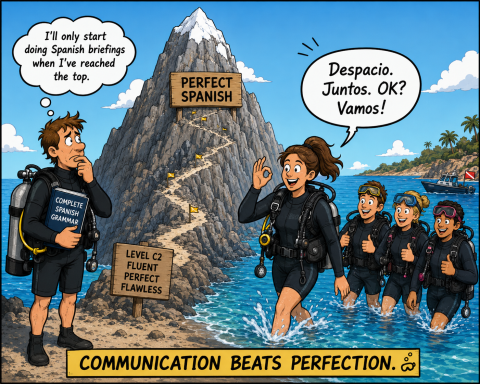
One of the biggest misconceptions about multilingualism is that you need to master a language before you can use it professionally. In reality, it works the other way around. You don't need to speak in perfect sentences or have flawless grammar. What matters is that your message is clear—and that people understand you.
In fact, in a diving environment, simple language often works better than complex, grammatically perfect sentences. Short, clear instructions are much easier to follow, especially when divers are already processing many things at once: their equipment, buoyancy, breathing, navigation, and the underwater environment. In that context, simplicity isn't a limitation—it is a strength.
Much of the communication that takes place during a dive isn't verbal at all. You use hand signals, point at objects, make eye contact, and confirm understanding with a nod or the familiar OK sign. This non-verbal layer carries a large part of the message. Language supports it, but it doesn't have to do all the work.
What really makes the difference isn't the size of your vocabulary—it's the structure of your communication. A briefing that always follows the same logical sequence, using familiar phrases at predictable moments, creates confidence and clarity. For you as the dive professional, but equally for your guests. Repetition makes communication predictable, and predictable communication is both clearer and safer.
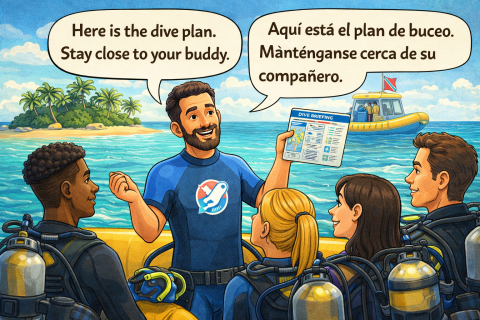
This leads to an important insight: a good briefing in simple—or even broken—Spanish is safer than a briefing in perfect English that your guests only half understand. The goal is not to impress people with your language skills. At the end of the day, nobody hands out awards for eloquence. The real goal is for your guests to understand what is going to happen, what is expected of them, and what they should do if something goes wrong. Perfection is not the objective. Understanding is. And that's exactly why you can start much sooner than you probably think.
There is also something surprisingly powerful about teaching or guiding in a language you haven't fully mastered yet. Your limited language skills naturally force you to keep things simple—and that's exactly what people need when they're learning something new. In your native language, or in a language you speak fluently, it's easy to elaborate, add extra details, or demonstrate how much you know about a subject. But that doesn't automatically make a briefing better. Quite the opposite.
When you give a briefing in a language you're still learning, you naturally focus on the essentials. You choose your words more carefully, keep your sentences shorter, and stay closer to the core message. As a result, your communication often becomes clearer and more effective.
Fewer words. More clarity.
What Is "Dive Language," Really?
When people think about learning a new language, they often imagine grammar rules, long vocabulary lists, complex sentences, and fluent conversations. But dive language works differently. The language you use as a dive professional is actually quite limited. In practice, you rely on a relatively small set of words and phrases that are repeated over and over again, usually in the same context and in the same order. That makes it far more manageable—and much easier to learn.
A dive briefing, for example, always covers the same topics: maximum depth, dive time, buddy procedures, ascent procedures, and the safety stop. During the dive, you once again use a limited set of words and hand signals. Even on the surface, you tend to ask the same questions over and over. In other words, you don't need to master an entire language. What you're really learning is a specific register—or perhaps even better, a script.
Dive language has three key characteristics:
- A limited vocabulary. You use a relatively small number of words and terms that keep coming back.
- Lots of repetition. The same instructions and phrases are used on virtually every dive, giving you endless opportunities to practice the same communication.
- A highly predictable context. Your communication always takes place in a familiar situation, making it much easier for both you and your guests to understand each other.
Let's make this practical. Suppose you can't remember the Spanish word for hose (manguera), or the German word for the purge button (Luftdusche). Simply pick up the piece of equipment, point to it, and ask your guest what it's called. After doing that a few times, you'll naturally remember the word. Many of the terms you'll need are short, practical, and often internationally recognized:
- descend / ascend slowly
- equalize
- stay together
- safety stop
- air check
- turn the dive
These aren't complicated sentences—they're simple, functional instructions that you'll use again and again. You're not learning an entire language. You're learning how to guide a dive in that language. And that's a much smaller step than it may seem at first.
After all, you already know how to guide dives—probably in one or even several other languages.
Building on What You Already Know
The diving world is largely English-speaking. Wherever you dive in the world, English is usually the common language between dive professionals and their guests. But here's something interesting: many diving terms are hardly translated at all. Words like BCD, regulator, buddy, safety stop, and divemaster are often used in English even when people are speaking Spanish, French, German, or many other languages.
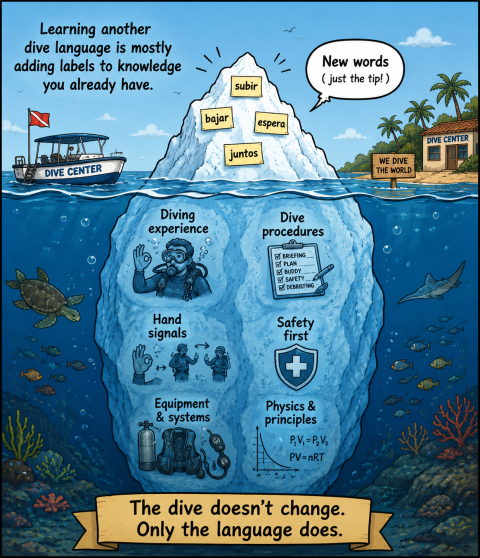
That means you're not starting from scratch. You're building on something you already know. Much of the terminology is already familiar, and whatever is new usually connects directly to concepts you use every day. You're not learning a completely new language—you’re learning a familiar language in a slightly different form.
When learning English, there was an additional challenge: different units of measurement. Divers had to get used to feet instead of meters, psi instead of bar, and Fahrenheit instead of Celsius (you can read more about that here). Fortunately, that challenge disappears when learning most other languages. Almost all of them use the same metric units and the same physical principles you're already familiar with.
Depth, time, and pressure don't change just because you switch languages. A safety stop is still three minutes at five meters. One hundred bar is still one hundred bar. Eighteen meters is still eighteen meters. You don't have to learn a new system—only new words.
That makes learning an additional language much less demanding than switching between metric and imperial measurements. In fact, languages other than English offer two major advantages: first, they already include a great deal of English diving terminology; and second, they use the same metric system you already work with every day.
How Do You Get Started?
Learning another language doesn't have to be a giant leap. You don't need to start by giving an entire briefing or teaching a complete course in a new language. Instead, start small and build your confidence step by step.
Step 1: Learn the Essential Words
Begin with the words you use most often—especially verbs and safety-related terms.
For example:
- descend
- ascend
- stop
- wait
- problem
- air
- stop
These are words you'll use on almost every dive. Once you know them, you'll already be able to support a large part of your communication.
Step 2: Learn a Few Standard Phrases
Next, add a handful of short, fixed phrases that you'll use over and over again.
For example:
- Stay close.
- Check your air.
- We're going to ascend now.
You'll quickly discover that a surprisingly small number of phrases allows you to communicate effectively. The goal isn't variety—it's clarity and consistency.
Step 3: Practice in Real Life
The best way to learn is simply to start using the language. Try giving small parts of a briefing in another language. Ask your guests a few simple questions in their own language. When necessary, combine it with English.
It doesn't have to be perfect. If your message is clear, you're already succeeding. In fact, many divers genuinely appreciate the effort when someone is learning their language. It's not unprofessional to work in a language you haven't fully mastered yet. Mastery comes through using a language—not before.
Step 4: Build Gradually
A good place to start is guiding dives. The communication is relatively simple, the instructions are short, and there's a lot of repetition. From there, you can gradually move on to more detailed briefings and eventually to teaching courses in another language.
As you gain experience, your confidence will naturally grow—and so will your language skills. You don't have to get everything right from day one. You simply have to begin.
To help you get started, the following chapters contain practical vocabulary lists and ready-to-use phrases in multiple languages. They focus on the words and expressions that dive professionals actually use every day, making them immediately applicable in your daily work.
The Multilingual Toolkit (6 languages)
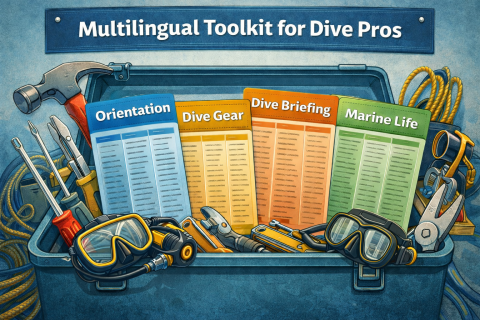
To help you get started, below you’ll find a number of practical multilingual overviews. Don’t see them as a complete dictionary, but as a compact toolkit you can use right away in your daily work as a dive professional.
The lists are organized in a fixed order: Dutch – English – Spanish – Portuguese – French – German. This way, you can easily compare the different languages and quickly find the right words or phrases. We have chosen these six languages because they are the most important in our practice. If you work in a different context, where for example Italian or Russian — or even Korean or Japanese — play a bigger role in dive tourism, you can easily adapt these lists to your own situation. With the help of tools like Google Translate or ChatGPT, you can rewrite them into the languages you want to work with.
We have divided the toolkit into four glossaries, which together follow a typical dive day:
A. Welcome phrases and orientation
The first conversations with your guests: greeting, asking questions, and preparing the dive.
B. Dive equipment
The most important terms for materials and equipment — useful when issuing, checking, and explaining gear.
C. Dive briefing
The standard phrases and instructions you use before and during the dive.
D. Marine life
The most common species you encounter during a dive — useful for your debriefing and post-dive conversation.
Use these lists as a starting point. You don’t have to memorize them. Choose a few words or phrases, try them out in practice, and build from there.
We begin with a few welcome phrases and some basic orientation.
The first conversations with your guests are often the easiest to practice. They follow a familiar pattern, use simple vocabulary, and are repeated several times a day. That makes them an ideal starting point for building confidence in another language.
In the tables below, you'll find the most common welcome phrases in six languages: English, Dutch, German, Spanish, Portuguese, and French.
|
NL |
EN |
ES |
PT |
FR |
DE |
|
Hallo, ik ben… |
Hello, I am… |
Hola, soy… |
Olá, eu sou… |
Bonjour, je suis… |
Hallo, ich bin… |
|
Ik ben je duikinstructeur |
I am your dive instructor |
Soy tu instructor de buceo |
Sou o seu instrutor de mergulho |
Je suis ton instructeur de plongée |
Ich bin dein Tauchlehrer |
|
Ik ben je divemaster |
I am your divemaster |
Soy tu divemaster |
Sou o seu divemaster |
Je suis ton divemaster |
Ich bin dein Divemaster |
|
Welkom bij Porto Mari Dive Center |
Welcome to Porto Mari Dive Center |
Bienvenido a Porto Mari Dive Center |
Bem-vindo ao Porto Mari Dive Center |
Bienvenue à Porto Mari Dive Center |
Willkommen bei Porto Mari Dive Center |
|
Fijn dat je er bent |
Nice to have you here |
Me alegra que estés aquí |
É um prazer ter você aqui |
Ravi de t’avoir ici |
Schön, dass du da bist |
|
Heb je al eens gedoken? |
Have you dived before? |
¿Has buceado antes? |
Você já mergulhou antes? |
As-tu déjà plongé ? |
Hast du schon einmal getaucht? |
|
Wat is je niveau? |
What is your certification level? |
¿Cuál es tu nivel de certificación? |
Qual é o seu nível de certificação? |
Quel est ton niveau de certification ? |
Welches Brevet hast du? |
|
Wat is je hoogste brevet? |
What is your highest certification? |
¿Cuál es tu certificación más alta? |
Qual é a sua certificação mais alta? |
Quel est ton niveau de certification le plus élevé ? |
Was ist dein höchstes Brevet? |
|
Wanneer was je laatste duik? |
When was your last dive? |
¿Cuándo fue tu última inmersión? |
Quando foi o seu último mergulho? |
Quand était ta dernière plongée ? |
Wann war dein letzter Tauchgang? |
|
Hoeveel duiken heb je? |
How many dives do you have? |
¿Cuántas inmersiones tienes? |
Quantos mergulhos você tem? |
Combien de plongées as-tu ? |
Wie viele Tauchgänge hast du? |
|
Ik ga een korte briefing geven |
I will give a short briefing |
Voy a dar un breve briefing |
Vou dar um briefing curto |
Je vais faire un briefing |
Ich gebe ein kurzes Briefing |
|
Daarna gaan we het water in |
Then we go into the water |
Después entramos al agua |
Depois entramos na água |
Ensuite nous allons à l’eau |
Danach gehen wir ins Wasser |
The next list focuses on diving equipment. This is arguably the core vocabulary of diving. While the previous section concentrated on short phrases for everyday communication, the tables below provide an overview of the most important equipment terms you'll encounter as a dive professional.
Think of these tables as a practical reference guide. Whenever you forget a word, you can quickly look it up and immediately use it in your next briefing or conversation.
You'll also notice how similar many of the terms are across different languages—and how much English diving terminology has been adopted internationally. That's one of the reasons why learning dive language is often much easier than people expect.
|
NL |
EN |
ES |
PT |
FR |
DE |
|
Masker |
Mask |
Máscara |
Máscara |
Masque |
Maske |
|
Maskerband |
Mask strap |
Tira de la mascara |
Tira da máscara |
Sangle de masque |
Maskenband |
|
Snorkel |
Snorkel |
Snorkel |
Snorkel |
Tuba |
Schnorchel |
|
Vinnen |
Fins |
Aletas |
Abarbatanas / Nadadeiras |
Palmes |
Flossen |
|
Vinband |
Fin strap |
Tira de la aleta |
Tira da nadadeira |
Sangle de palme |
Flossenband |
|
Duikschoenen |
Dive boots |
Botas |
Botas |
Bottillons |
Tauchschuhe |
|
Natpak |
Wetsuit |
Traje húmedo |
Fato de neoprene |
Combinaison humide |
Nassanzug |
|
Shorty |
Shorty |
Shorty / traje corto |
Shorty / fato curto |
Shorty |
Shorty |
|
Langpak |
Full wetsuit |
Traje largo |
Fato completo |
Combinaison intégrale |
Ganzanzug |
|
Neopreen |
Neoprene |
Neopreno |
Neoprene |
Néoprène |
Neopren |
|
Droogpak |
Drysuit |
Traje seco |
Fato seco |
Combinaison étanche |
Trockentauchanzug |
|
Trimvest (BCD) |
BCD |
Chaleco (de buceo) |
Colete equilibrador (BCD) |
Gilet stabilisateur (BCD) |
Tarierjacket (BCD) |
|
Ademautomaat |
Regulator |
Regulador |
Regulador |
Détendeur |
Atemregler |
|
Eerste trap |
First stage |
Primera etapa |
Primeiro estágio |
Premier étage |
Erste Stufe |
|
Tweede trap |
Second stage |
Segunda etapa |
Segundo estágio |
Deuxième étage |
Zweite Stufe |
|
Mondstuk |
Mouthpiece |
Boquilla |
Bocal |
Embout |
Mundstück |
|
Octopus |
Octopus |
Octopus |
Octopus |
Octopus |
Oktopus |
|
Alternatieve luchtvoorziening |
Alternate air source |
Fuente de aire alternativa |
Fonte de ar alternativa |
Source d’air alternative |
Alternativluftversorgung |
|
waterloosventiel / Spoelknop / Purgeknop |
Purge button |
Botón de purga |
Botão de purga |
Bouton de purge |
Ablassknopf |
|
Manometer |
Pressure gauge / SPG |
Manómetro |
Manómetro |
Manomètre |
Finimeter |
|
Dieptemeter |
Depth gauge |
Profundímetro |
Profundímetro |
Profondimètre |
Tiefenmesser |
|
Slang |
Hose |
Manguera |
Mangueira |
Flexible |
Schlauch |
|
Hoge druk slang |
High pressure hose |
Manguera de alta presión |
Mangueira de alta pressão |
Flexible haute pression |
Hochdruckschlauch |
|
Lage druk inflator slang |
Low pressure inflator (LPI) hose |
Manguera de baja presión |
Mangueira de baixa pressão |
Flexible basse pression |
Niederdruckschlauch |
|
Inflator |
Power inflator |
Inflador |
Inflador |
Inflateur |
Inflator |
|
Inflate knop / inblaasknop |
Inflate button |
Botón de inflado |
Botão de inflar |
Bouton de gonflage |
Inflationstaste |
|
Deflate knop / ontluchtingsknop |
Deflate button |
Botón de desinflado |
Botão de desinflar |
Bouton de purge / dégonflage |
Ablassknopf |
|
Fles (tank) |
Tank / Cylinder |
Tanque / Botella |
Garrafa / Cilindro |
Bouteille |
Flasche |
|
Kraan |
Valve |
Válvula |
Válvula |
Robinet |
Ventil |
|
Burst disk |
Burst disk |
Disco de ruptura |
Disco de ruptura |
Disque de rupture |
Berstscheibe |
|
DIN insert |
DIN insert |
Inserto DIN |
Inserto DIN |
Insert DIN |
DIN-Einsatz |
|
O-ring |
O-ring |
O-ring / junta tórica |
O-ring / junta tórica |
Joint torique |
O-Ring |
|
Lucht |
Air |
Aire |
Ar |
Air |
Luft |
|
Duikcomputer |
Dive computer |
Ordenador / computadora de buceo |
Computador de mergulho |
Ordinateur de plongée |
Tauchcomputer |
|
Duikboei / Oppervlakteboei / SMB |
Surface marker buoy (SMB) / safety sausage / divers buoy |
Boya de señalización / SMB |
Bóia de sinalização / SMB |
Bouée de signalisation / SMB |
Signalboje / SMB |
|
Duikboei / Oplaatboei / DSMB |
Delayed Surface Marker Buoy / DSMB |
Boya de señalización / DSMB |
Bóia de sinalização / DSMB |
Bouée de signalisation retardée / DSMB |
Boje (dekomprimierbar) / DSMB |
The following section returns to complete sentences. You can think of it as a blueprint for a dive briefing in six languages. If you've been giving briefings for years, you'll immediately recognize the structure: these are the standard elements that appear in almost every briefing, regardless of where you dive.
Use these sentences as a foundation. Adapt them to your own style and to the specific dive you're leading. You'll soon discover that a relatively small collection of standard phrases is enough to deliver an effective briefing in another language.
|
NL |
EN |
ES |
PT |
FR |
DE |
|
Ik ben je duikgids |
I am your dive guide |
Soy tu guía de buceo |
Sou o seu guia de mergulho |
Je suis ton guide de plongée |
Ich bin dein Tauchguide |
|
De duiktijd is … minuten |
The dive time is … minutes |
El tiempo de buceo es de … minutos |
O tempo de mergulho é de … minutos |
Le temps de plongée est de … minutes |
Die Tauchzeit beträgt … Minuten |
|
De maximale diepte is … meter |
The maximum depth is … meters |
La profundidad máxima es de … metros |
A profundidade máxima é de … metros |
La profondeur maximale est de … mètres |
Die maximale Tiefe beträgt … Meter |
|
We gaan langzaam afdalen |
We descend slowly |
Vamos a descender lentamente |
Vamos descer lentamente |
Nous allons descendre lentement |
Wir steigen langsam ab |
|
Ik zwem voorop, volg mij alsjeblieft |
I swim in front, please follow me |
Nado delante, sígueme por favor |
Nado na frente, siga-me por favor |
Je nage devant, suis-moi s’il te plaît |
Ich schwimme vorne, folge mir bitte |
|
Blijf altijd bij je buddy |
Always stay with your buddy |
Mantente siempre con tu compañero |
Fique sempre com o seu buddy |
Reste toujours avec ton binôme |
Bleib immer bei deinem Buddy |
|
Doe een buddycheck voor de duik |
Do a buddy check before the dive |
Haz un chequeo de compañero antes de la inmersión |
Faça um buddy check antes do mergulho |
Fais un contrôle du binôme avant la plongée |
Mache einen Buddy-Check vor dem Tauchgang |
|
Blijf boven mij (niet dieper dan mij) |
Stay above me, do not go deeper than me |
Mantente por encima de mí, no bajes más profundo que yo |
Fique acima de mim, não desça mais fundo do que eu |
Reste au-dessus de moi |
Bleib über mir; gehe nicht tiefer als ich |
|
Blijf ook achter mij (haal mij niet in) |
Stay behind me (do not overtake me) |
Mantente detrás de mí (no me adelantes) |
Fique atrás de mim (não me ultrapasse) |
Reste derrière moi (ne me dépasse pas) |
Bleib hinter mir (überhole mich nicht) |
|
Ken je de belangrijkste handsignalen nog? |
Do you remember the main hand signals? |
¿Recuerdas las señales manuales principales? |
Você lembra dos sinais manuais principais? |
Tu te souviens des principaux signes de la main ? |
Kennst du die wichtigsten Handzeichen noch? |
|
Ik zal je regelmatig vragen of je ok bent |
I will regularly ask if you are ok |
Te preguntaré regularmente si estás bien |
Vou perguntar regularmente se você está bem |
Je te demanderai régulièrement si ça va |
Ich werde dich regelmäßig fragen ob alles in Ordnung ist |
|
Ik vraag af en toe naar je lucht |
I will check your air from time to time |
De vez en cuando te preguntaré por tu aire |
De vez em quando vou verificar o seu ar |
Je vérifierai ton air de temps en temps |
Ich frage gelegentlich nach deiner Luft |
|
Geef het aan als je weinig lucht hebt |
Let me know if you are low on air |
Avisa si tienes poco aire |
Avise quando estiver com pouco ar |
Dis-moi si tu as peu d’air |
Gib Bescheid wenn du wenig Luft hast |
|
Geef aan wanneer je 100 bar en 50 bar hebt |
Let me know when you have 100 bar and 50 bar |
Avisa cuando tengas 100 bar y 50 bar |
Avise quando tiver 100 bar e 50 bar |
Indique-moi quand tu as 100 bar et 50 bar |
Sag mir wenn du 100 bar und 50 bar hast |
|
Bij 100 bar of na … minuten keren we om |
At 100 bar or after … minutes we turn the dive |
Con 100 bar o después de … minutos damos la vuelta |
Com 100 bar ou após … minutos voltamos |
À 100 bar ou après … minutes nous faisons demi-tour |
Bei 100 bar oder nach … Minuten drehen wir um |
|
We stijgen langzaam op, samen als groep |
We ascend slowly together as a group |
Subimos lentamente juntos como grupo |
Subimos lentamente juntos como grupo |
Nous remontons lentement ensemble comme groupe |
Wir steigen langsam gemeinsam als Gruppe auf |
|
Bij 50 bar beginnen we aan onze veiligheidsstop (3 minuten op 5 meter) |
At 50 bar we start our safety stop (3 minutes at 5 meters) |
A 50 bar empezamos nuestra parada de seguridad (3 minutos a 5 metros) |
Com 50 bar começamos a nossa parada de segurança (3 minutos a 5 metros) |
À 50 bar nous commençons notre palier de sécurité (3 minutes à 5 mètres) |
Bei 50 bar beginnen wir unseren Sicherheitsstopp (3 Minuten auf 5 Meter) |
|
Als je een probleem hebt, geef een signaal |
If you have a problem give a signal |
Si tienes un problema da una señal |
Se você tem um problema, faça um sinal |
Si tu as un problème fais un signe |
Wenn du ein Problem hast gib ein Zeichen |
|
Als je je buddy verliest: zoek 1 minuut en ga dan omhoog |
If you lose your buddy search for 1 minute and then go up |
Si pierdes a tu compañero busca durante 1 minuto y luego sube |
Se você perder o seu buddy, procure por 1 minuto e depois suba |
Si tu perds ton binôme cherche pendant 1 minute puis remonte |
Wenn du deinen Buddy verlierst suche 1 Minute und tauche dann auf |
Finally, you'll find a concise multilingual vocabulary of marine life that divers commonly encounter underwater. This section is mainly intended for post-dive conversations, helping you name the animals and marine life you've seen during the dive.
As your language skills improve, you'll naturally want to expand this list with additional species that are common in your own diving environment.
|
Schildpad |
Turtle |
Tortuga |
Tartaruga |
Tortue |
Schildkröte |
|
Barracuda |
Barracuda |
Barracuda |
Barracuda |
Barracuda |
Barrakuda |
|
Murene |
Moray eel |
Morena |
Moréia |
Murène |
Muräne |
|
Rog |
Ray |
Rayas |
Raia |
Raie |
Rochen |
|
Adelaarsrog |
Eagle ray |
Raya águila |
Raia-águia |
Raie aigle |
Adlerrochen |
|
Pijlstaartrog |
Stingray |
Raya |
Raia |
Raie |
Stachelrochen |
|
Koraal |
Coral |
Coral |
Coral |
Corail |
Koralle |
|
Zacht koraal |
Soft coral |
Coral blando |
Coral mole |
Corail mou |
Weichkoralle |
|
Hersenkoraal |
Brain coral |
Coral cerebro |
Coral cérebro |
Corail cerveau |
Gehirnkoralle |
|
Koraalrif |
Coral reef |
Arrecife de coral |
Recife de coral |
Récif corallien |
Korallenriff |
|
Spons |
Sponge |
Esponja |
Esponja |
Éponge |
Schwamm |
|
Kokerspons |
Tube sponge |
Esponja tubular |
Esponja tubular |
Éponge tubulaire |
Röhrenschwamm |
|
Anemoon |
Anemone |
Anémona |
Anémona |
Anémone |
Anemone |
|
Papegaaivis |
Parrotfish |
Pez loro |
Peixe-papagaio |
Poisson-perroquet |
Papageifisch |
|
Doktersvis |
Surgeonfish |
Pez cirujano |
Peixe-cirurgião |
Poisson chirurgien |
Doktorfisch |
|
Koraalduivel |
Lionfish |
Pez león |
Peixe-leão |
Poisson-lion |
Rotfeuerfisch |
|
Trompetvis |
Trumpetfish |
Pez trompeta |
Peixe-trombeta |
Poisson trompette |
Trompetenfisch |
|
Kogelvis |
Pufferfish |
Pez globo |
Baiacu |
Poisson-globe |
Kugelfisch |
|
Pijlstaartinktvis |
Squid |
Calamar |
Lula |
Calmar |
Kalmar |
|
Octopus |
Octopus |
Pulpo |
Polvo |
Poulpe |
Oktopus |
|
Haai |
Shark |
Tiburón |
Tubarão |
Requin |
Hai |
|
Verpleegsterhaai |
Nurse shark |
Tiburón nodriza |
Tubarão-lixa |
Requin nourrice |
Ammenhai |
Use these tables as a practical toolkit rather than something you need to memorize like a school vocabulary list. You don't have to study every word by heart. Instead, think of them as a reference that you can consult whenever you need it, gradually picking up new words and phrases along the way.
Choose a few terms or expressions that appeal to you, use them with your guests, and slowly build from there.
As with every new skill, the beginning may feel a little awkward. And that's perfectly normal. In the next chapter, we'll look at the most common pitfalls—and, more importantly, how to avoid them.
Common Pitfalls
When you start using an additional language in your work as a dive professional, you'll notice that things usually improve quite quickly. Still, there are a few pitfalls that almost everyone encounters at the beginning. The first is wanting too much too soon. You try to form complete sentences, add nuances, or speak more complicated than necessary. But simplicity actually works best. Short, clear instructions are not only easier for you, but also for your guests.
A second pitfall is translating literally. What sounds logical in Dutch doesn't always work in another language. Sometimes there's a different, more common way to say the same thing—or a term is simply used in English. It helps to focus on what works in practice, rather than what is literally correct. Jargon can also get in the way. As a professional, you're used to certain terms, but for guests—especially beginners—these aren't always obvious. In another language, this effect is often even stronger. So keep it simple and avoid unnecessary jargon.
And perhaps the most important: never lose sight of what matters. Multilingualism is a tool, not a goal in itself. Safety and clarity always come first. If something doesn't work well in another language, simply switch back to what does work. And you can use any tools you can think of: from hands and feet, to colleagues, to Google Translate or ChatGPT. There's no such thing as cheating in communication. But most of the time, you'll be able to reach understanding with your guest through interaction.
Regularly ask your guests if they have understood you. And feel free to mention in advance that you are still learning the language. You'll find that this actually works to your advantage: people usually respond with encouragement and appreciation for your effort. In fact, guests often want to help you. They offer words, fill in gaps, and help you expand your vocabulary without you even noticing.
Making mistakes is part of the process. In fact, it's an essential part of learning. As long as your message is clear, you're doing fine. There's even a nice irony in it. The more basic your level, the more encouragement and compliments you often receive. As you become more proficient in the language, those compliments decrease—and you get more corrections instead. Those compliments naturally feel good, and corrections sometimes a bit less so. But in reality, it's exactly the opposite: the compliments often mean you're still at the beginning, while corrections actually show that you're making progress. In a way, they are the greatest compliment.
Conclusion
Multilingualism in diving isn't about speaking perfectly. It's about being understood. You don't have to be able to do everything. You just have to start. The rest is already in your toolkit.
Start small. Learn your first twenty words. Use a few sentences from this page. Try it on your next dive.
You'll notice how quickly it goes. How natural it becomes. And how big the difference is for your guests. Before you know it, you'll be giving your first briefing in a new language. And from that moment on, there's no turning back.
