


Scuba tanks with compressed air (air)
Always the right tank for your dive.
With more than 150 aluminum tanks in six sizes — from children's to sidemount and nitrox tanks — we ensure comfort, safety, and maximum dive time.
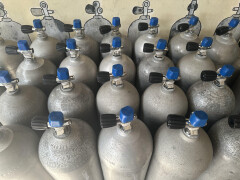
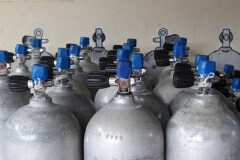
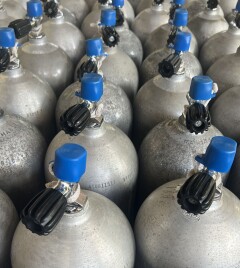
We have approximately 150 aluminum dive tanks from the renowned American brands Catalina, Luxfer, and Piper, in six different sizes. This allows us to offer a suitable tank for virtually every diver — from young to old, from extremely air-efficient to high air consumption.
Our standard tank is the 80 cubic feet (cuf). This tank has an internal volume of 11.1 liters and is commonly referred to as a “12-liter”. That’s understandable, but technically not entirely correct. Below is an overview of our tanks, with both the official specifications and the common names.
Overview of our tanks
Size (cuf)Internal volumeCommon nameTypical use
| 100 cuf | 13.8 liters | “15 liter” | Large tank, suitable for divers with higher air consumption |
| 80 cuf | 11.1 liters | “12 liter” | Standard tank, good for approx. 45–60 minutes of diving |
| 63 cuf | 9.0 liters | “10 liter” | Smaller tank for the air-efficient user |
| 50 cuf | 6.9 liters | “7 liter” | Extra small tank, e.g. for younger children |
| 40 cuf | 5.7 liters | “6 liter” | Stage tank, for example during decompression dives |
| 19 cuf | 2.6 liters | “3 liter” | Pony tank, used during the Independent Diver course |
Connections: DIN and INT
Most of our tanks are suitable for both DIN and INT regulators. This way, we can support any configuration without any issues.
-
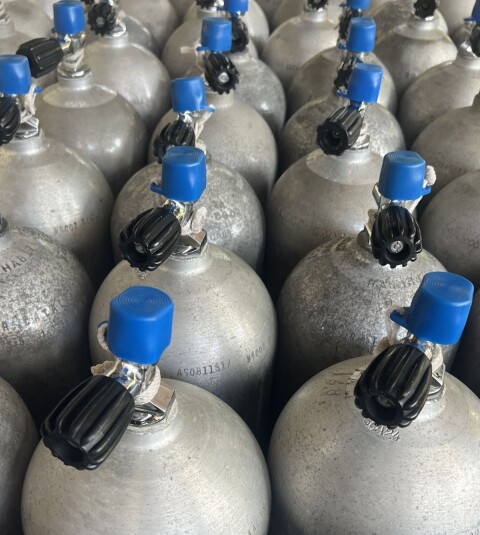
Tanks with blue caps are DIN-compatible and have an insert that can be easily placed or removed with an 8 mm Allen key.
-
Tanks with black caps are not DIN-compatible.
Did you know…?
On Curaçao (and throughout the Caribbean), diving is done almost exclusively with aluminum tanks. This is a conscious and practical choice:
-
Aluminum does not rust and is better suited to the warm, salty, and humid climate
-
They are lighter and easier to handle, especially for shore dives — the most common way of diving on Curaçao
-
Aluminum tanks become slightly positively buoyant underwater as they empty, which is pleasant and easy to control for recreational divers with trim and weights
Steel tanks, on the other hand, remain negatively buoyant and are therefore mainly used in cold water or technical diving. For the way diving is done here — relaxed, recreational, and often from the shore — aluminum tanks are simply the most logical choice.
Information
$12 | 20 XCG
